Showing posts with label Englishness. Show all posts

Tuesday, January 16, 2007

Rudyard Kipling

"Kim", the great poem of the Indian Atlantis...


Sorry to bother the Right Honourable Reader with Lawrence Durrell again, but this time it's about something he said not anything he wrote. Durrell was born in Dharjeeling, in Raj times, and he considered himself a "colonial" and an "Anglo-Indian". (Surprising choice of term if one remembers that it is normally used for someone of mixed Indian and British descent, which was not his case. He was more like "white trash", as one would say now. Or a British "pied noir"). Anyway he said this:
"I was born into that strange world of which the only great poem is the novel "Kim" by Kipling " .

Maria Martha

Cambridge Circus...


Homerton College, Cambridge
Stop the press! Breaking news! She did it! My very own Gillmore-girl made it... All going well, next October I'll have my Little Seal at Cambridge... Well done, Girl..

As the moth said, while still inside the dark cocoon : "From here I will leave flying!".

Have a grand flight at Homerton, my beautiful Butterfly!

Tuesday, January 09, 2007

T S Eliot


You find yourself in a slightly strange party in the End-of-the-Night and then you meet Eliot at pee-time...

Shane Warne

We were all bowled over by this sportsman...


Shane Warne about to release a missile...


The reason why this blogger of yours enjoys cricket has nothing to do with the more obvious part of it. Batting is like pop music for the masses while bowling is more like a shostakovitch-like complex composition. Mr Shane Warne, an extremely talented Australian cricket player, was able to marvel us with his deliveries. Almost against the Laws of Physics that govern motion. He is retiring from Test Match cricket after a whitewash of the England team, when Australia regained the Ashes.

I saw him at Lord's, almost two decades ago, having secured an unatainable ticket by bluffing all the way to the General Secretary of the MCC. The gentlemen with "bacon and egg" ties of that most English of clubs (Marylebone Cricket Club) were impressed that a barbarian from a non-cricketing country could be so enthusiastic about the Game. Howzat?

I tried to start a tradition when I was posted in London. Ensuring that at least one of the diplomats at the Embassy at a given time would be able to read the results columns of a cricket match. I'm afraid I was not successful.

I still remember reading hastily the booklet "Bluff your way in Cricket" on the eve of my first match at Lord's... It seemed intelectually challenging but with no real emotion on the pitch.. And then a certain Shane Warne started to run...


Friday, December 15, 2006

Lord Kitchener

Classical diplomatic stuff, courtesy Duff Coopper, Esq.


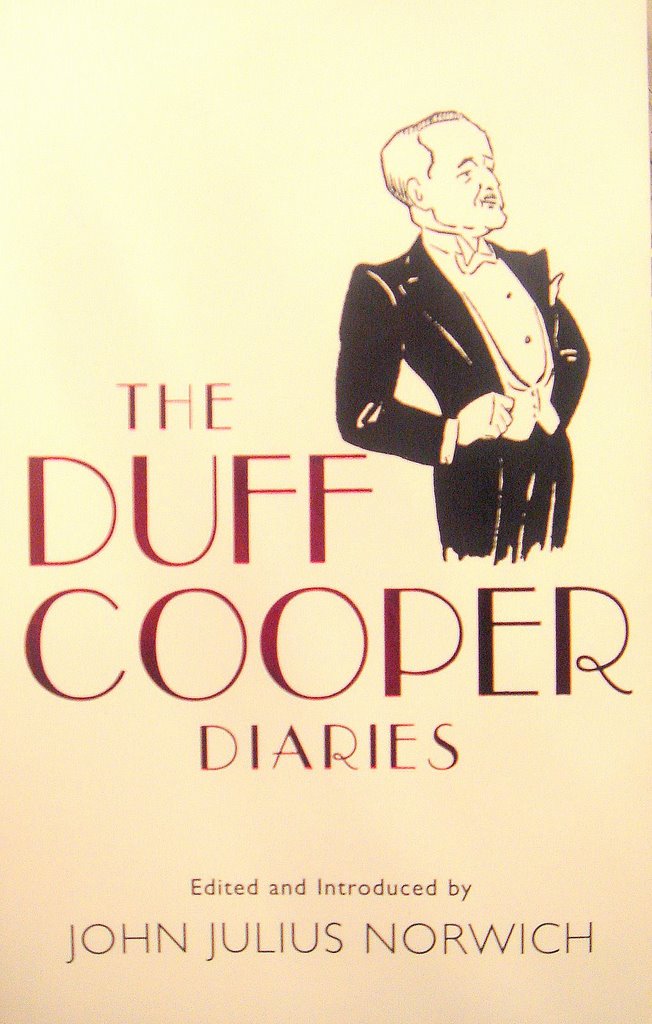
Of all the books this blogger of yours bought in Cambridge University territory while awaiting patiently the end of a daughterly interviewing process, the "Duff Cooper Diaries" is the real treat. Duff Cooper is the very epithome of the diplomat-as-witness-of-History-in-the-making. Plus, he was a top class lady-izer, a sybarite and a charming fellow. As a metaphorical carrot that will make the Right Honourable Reader run to his nearest amazon.com site, I'm considering quoting a couple of nuggets of the said diaries.
Think of today's Mesopotamia (Irak) and just enjoy this entry:


July 11, 1916

(…) Dined at 10 Downing Street (…) At first I felt very uncomfortable , alone with three Cabinet Ministers who I feared would say things I should not hear. But they seem quite unaware of my presence. The talked about the campaign in Mesopotamia. The mismanagement they said was all due to (…) .The decision to attempt the capture of Baghdad was entirely due to the military experts. Kitchener said that we might take it but couldn’t hold it. Even so he thought it worth doing from a political point of view. Curzon said: “Don’t take it unless you can hold it”.. (…)
Deliciously ironical, no?...

Monday, December 11, 2006

Saint John the Evangelist

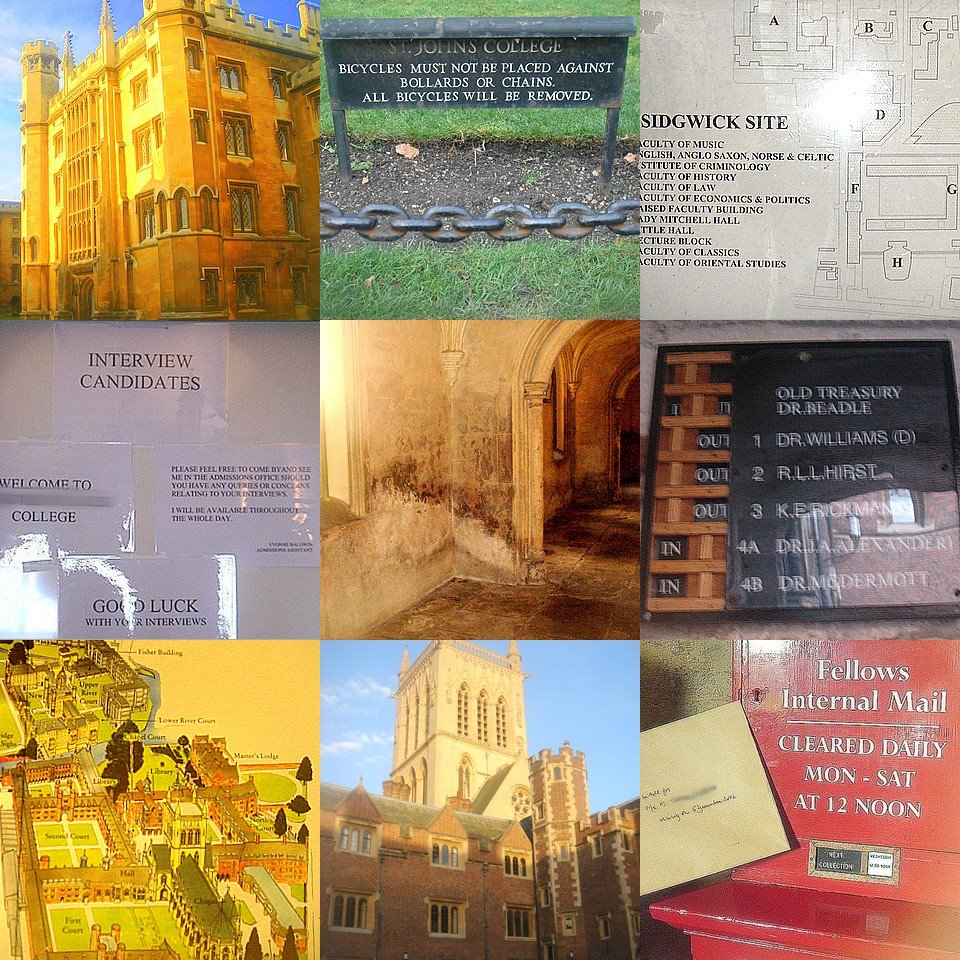
A most educational trip to Cambridge University...


A young lady who has the stamina and resilience to go all the way to an interview to an Oxbridge institution for Higher Education is in itself something that deserves praise.. When that young lady happens to be a daughter of this blogger of yours, opening therefore a ready-made alibi to one's return to dear England, what can one say?
Father-and-Daughter bonding can't go much better than this...

Giorgio Armani

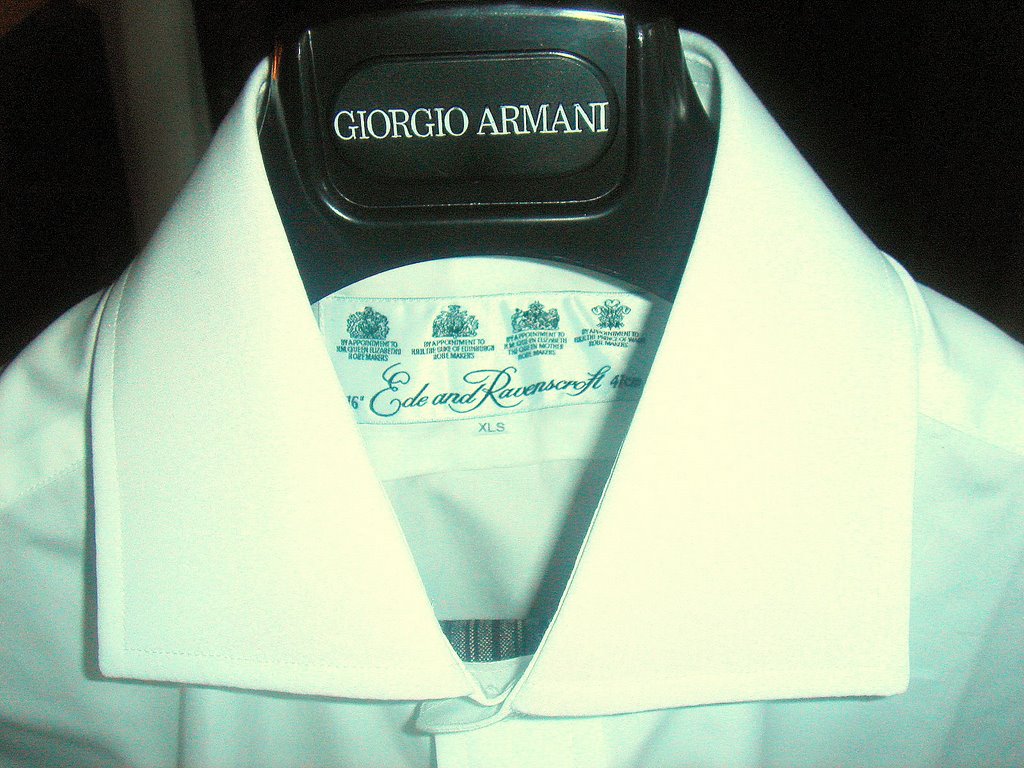
Old new trends in morning-coat fashion...


100% Cotton, pure white, size 16, XLS...


One never knows if, shirt-wise, there is a new trendy way to wear the marriage outfit known as morning-coat. Who could be better suited to give a frank opinion than the manager of "Ede and Ravenscroft" at Cambridge? Centuries of "by appointments", a bastion of dress-code orthodoxy...

"Plain white is very much the acceptable thing, Sir" - he said. The advice was duly followed..

The "XLS", one can spot under the label, reminds one of a tunning-prone motorcar but indicates, in fact, the generosity of the shirt-maker in providing Extra Long Sleeves...

Monday, November 20, 2006

Charles II

Roman Catholic Englishmen Abroad


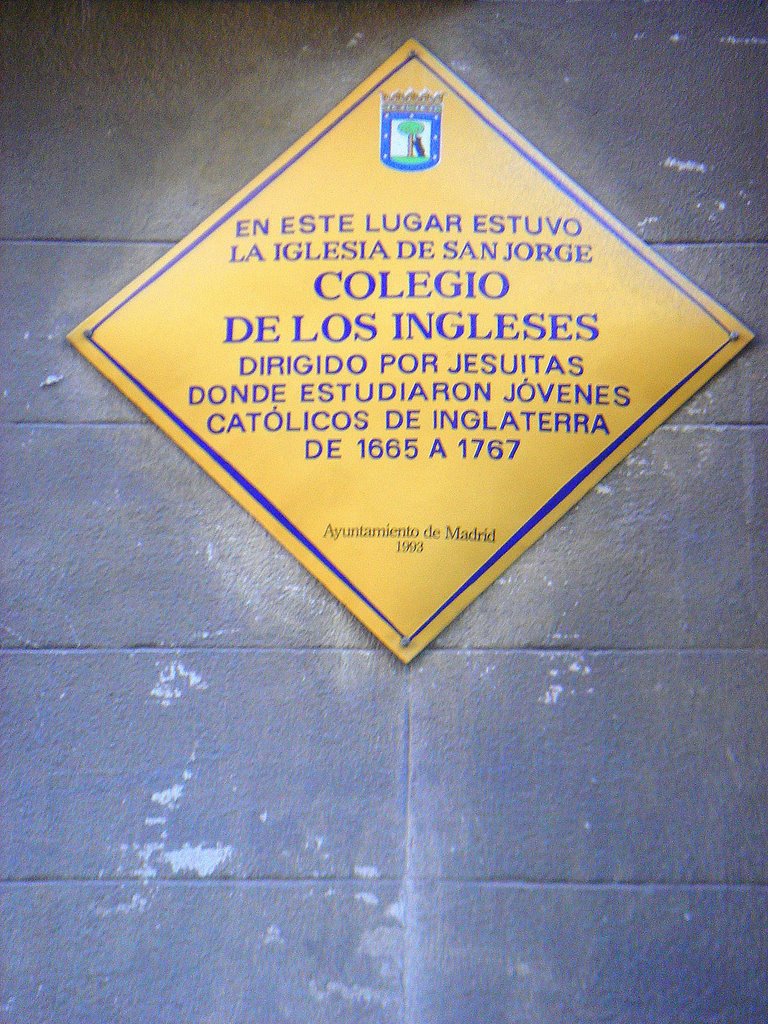
The "Colegio de Los Ingleses", in St. George's Church, where under Jesuit supervision Young English Catholics studied between 1665 and 1767


How to make some sense out of the 1665-1767 mentioned as lifetime of the Jesuit school in St George's Church? The politico-religious war in the British Isles is too complex for a mere blog. Suffice to say that Charles II was restored to the throne in 1660; that by an Act of Parliament of 1678 all Catholics were barred from parliament; that the Toleration Act of 1689 excluded Catholics and Unitarians from his target-audience; that the 1701 Act Of Settlement barred Catholics from ever occupying the English throne. 1707 is the year of the Act of Union (ending Scottish-originated turbulence) . The United Kingdom adopted the Gregorian calendar in 1752. George II becomes king in 1760. In 1763 the Seven Year War ends.

Friday, November 17, 2006

Anthony Wedgwood-Benn

The Queen in pre-Revolutionary times...


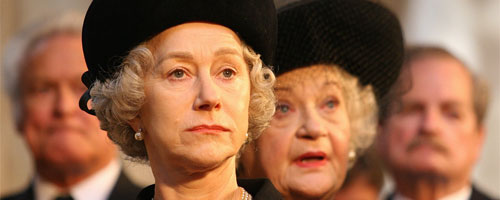
Helen Mirren's acting talents are mind-boggling...


One of this blogger of yours more striking memories of his half-decade spent in London was, beyond reasonable doubt, a lecture by a lionized Tony Benn. A Labour Party conference fringe meeting or a Quakers-organized lunch, can’t remember. But I do remember the title: “A Case for a British Republic”. Anthony Wedgwood-Benn was the Prince Kropotkin of the British ruling class. Very much a member of the higher echelons of the gentry by birth and schooling, he went on to consistently attack the Crown as an un-democratic stain at the heart of the British political system. On that lecture he warned that the British masses in a revolutionary moment - when the deference wall would have collapsed - would act as sans-culottes, metaphorically parading the heads of the Lords in their spikes.
It didn't turn out that way in the end. The escalating and retaliatory violence of class-war has been kept at bay (and does not infect the British political arrangement) by the tremendous brilliance of a few politicians who understood the risks.. Mrs Thatcher with her “popular capitalism” agenda delayed the Jacobin irruption and Mr Blair, with “New Labour” reforms in fox-hunting and the House of Lords, completed the job.

Why boring the Right Honourable Reader with all this stuff? Well. Let’s call it background reading for an entertaining masterpiece in the political film category. Go and see Stephen Frear's “The Queen” with a Ms. Helen Mirren more real as Lillybeth than that, you die. The “Courtiers” (from Buckingham, St. James’s L.C.O. or Balmoral) and the Sovereign Herself had to be rescued from pre-Bastille troubles by a political leader who showed a remarkable sang-froid. Blair was for a few days the successful Lafayette that Marie Antoinette, helas, never got.

Okay, the Monarchy was never at risk of sudden overthrow but one still has the words of Tony Benn echoing in one’s ears...

Wednesday, November 15, 2006

Catherine of Braganza

Goa is not just trance-music...


A Goan Cemetery...


Mr. D.J. Madan, from Mumbai 400 026, India, send a delicious Letter to the Editor, in this Saturday's FT regarding an old graveyard in Goa for British soldiers ("The Goan cemetery and the activist prime minister"). He recalled a visit to the area in 1983 from Mrs. Thatcher, who fumed when she realized in what poor shape the graveyard was. The iron baroness-to-be ordered HM's High Commissioner to do something about, no later than immediately. Writes Mr. Madan:


" There was much speculation as to who these British soldiers were and how they came into a territory that was Portuguese from early in the 16th century, particularly as there is no record of warfare betweeen Britain and Portugal in Goa. A clue can be found in an old Bombay Gazetteer which records that although Bombay was cede to the English by the Portuguese in 1641 following the marriage of Charles II to the Infanta Catherine of Portugal, the local Portuguese and their priests who had been in possession of Bombay for a century or more, refused to part with the territory putting forth all sorts of procedural difficulties.


Some of the English ships, which had come for the takeover, sailed back but a couple were sent off to Goa where they were denied entry and the crew banished to an unoccupied island, Anjandiv, "12 leagues to the south of Goa" where they are said to have perished one by one in a few years, due to lack of proper food and an unfamiliar climate. It is possible that the graveyard the then prime minister visited was of those unfortunate sailors."


I rush to calm the Right Honourable Reader who might have found himself under the impression that this blogger of yours cannot disguise his nostalgia for Imperial times. This story merely represents a very proper and well-behaved way to remind a lost era, when crews of ships of Her Britanic Majesty could be banished to the Anjandivs of this world by Europeans less choosy in their dietary habits and less susceptible to climate-change...

Monday, November 13, 2006

Ian Fleming

James Bond re-revisited...


UST between Miss Moneypenny and James...


Kate Westwood has been writing a sequel to Fleming's set of characters, from the view point of the butler... sorry, the trusted secretary, Miss Moneypenny. Good fun. Aside from the obvious commercial reasons for doing it, there is an almost childish frisson in make-believe stories involving Bond, James Bond. He has an iconic dimension that exerts the same kind of attraction for a novel writer than "Las Meninas" for a Spannish painter or James Brown's "The Sex Machine" for a rapper sampler. The teasing around in "The Moneypenny Diaries" about the near physical relationship between Jane Moneypenny and James Bond was already part of the original Fleming sub-context. As they say in Hollywood, nothing sells more than UST (Unresolved Sexual Tension)...

Wednesday, May 10, 2006

David Fromkin

"1922" was a crucial historical "nodule" ...


There’s too much information out there. Better to stick to a few areas, and among them to a few themes, and then, alright, be thorough, be deep.

Malinka liked my “nodules” concept for a crash course on world history and wants me to elaborate on that. I longed for a similar request from the Right Honourable Reader but to no avail.

To acquire historical knowledge from A to Z is rather tiresome if not physically impossible (considering the average life expectancy of the Homo sapiens). Instead of starting with the Neanderthal, progressing to Oriental and Classical Antiquity, and from there to the European heirs of Rome until this day and age of evil-axis metaphors and near-non-Nonproliferators an alternative methodology might be on order. Less time-consuming and, intellectually-speaking, much more rewarding.

All bores quote themselves and I will have to conform with norm: “I believe in a kind of 'quanta' or Darwinian evolutionary History. More important than a slow chronological flux are some crucial "nodules". I mean by that historical short periods which have critical mass of data, revolutionary energy and political "pathos" (either drama or tragic-comedy) enough to carry us - in a quantum-like leap - into new times.”


I have also bored stiff the Right Honourable Reader enough times already with some of my favourite A-list “nodules”. A good example is the Russian Revolution one, which I could label, to simplify, “1917”. If one tries hard to understand “1917” almost every single political development in XX Century, from Marx to Fukuyama, becomes intelligible. Worth some studying then.


What other “nodules” in the Rosary of History are worth a particular investment, bearing in mind one’s scarce resources of Time, Intelligence and energy? As it is impossible to achieve wisdom on every significant crossroad of the History of men, each one of us chooses personally a couple of “nodules” to occupy his free moments of an otherwise full-agenda hyper-busy day-to-day life.

Those choices are sometimes dictated by professional interest. When I was trying to figure out, while watching successive sunsets in Jaffa, what was the Israeli-Arab conflict all about, I had to concentrate in “1922” (the Versailles arrangement for a semi post-colonial Middle East). For that Professor Fromkin's book (depicted above) was outstanding. I obviously had also to dive into “1948-69-73" and in “1956” too (yes, the demise of British Imperial Power in Suez is a nodule worth studying.. ).

Some times our choices are just guided by our patriotic personal inclinations. A Christian, in a way, is always returning to the nodule “1 to 33 A.D.”.. A French nostalgic of Napoleonic Imperial Grandeur to “1812” – and to achieve full understanding of Waterloo he will have to end up, as all Frenchmen do, in “1789”.. In the westernmost Peninsula of Europe where I was born, “1492” and “1500, plus or minus a couple of decades” are still obsessively revisited.

Some choices for “nodular” historical research are biography-led, though. As I blogged about recently (boring self-quoting activity again): “In each “nodule” there are illuminating biographical case-studies. Among these particular revealing biographies, as code-breakers to certain periods of history, I’ve always had a fascination for gentlemen who incurred in many risks to protect their individual freedoms and beliefs (…) “ . What produces a Free Spirit? What is so precious about Individual Freedom that turns the rise of Freedom in Society into an almost secondary phenomenon? What makes one admire an atheist among a bigot religious society, or a believer in an atheistic regime, more than the glorious struggle of the Masses? Why would one rather fall for Casanova than for Marx? Why will one always tend to prefer Pasternak to Gorky? And what contributes more to the loosen up of strict hypocritical sexual morals, a rebellious serial seducer like Lord Rochester or the Kinsley Report?

- Will this do, Madam?

Tuesday, May 09, 2006

Samuel Pepys

The Patron Saint of us web-loggers...

Pronounce after me: "Peeps".. That's right.. "Peeps"
After what I have brainloaded these last weeks on "Restoration" I felt comfortable enough to go to my bookshelves looking for the biography on Samuel Pepys (pronounce "peeps") I knew I had bought sometime ago. Not only I found Claire Tomalin's "Samuel Pepys - The unequalled self" delicious reading but I wrote a quite nice blogtext about it. Suddenly, catastrophe! At the very last turn of the publishing process, with checkspelling completed and last editing touches firmly behind me , I had the terror-inducing "system failure" message on the screen.
The text went AWOL, un-saved, in the electronic ether. No matter how many hacker-like techniques I tried to retrieve the bloody text (if the Right Honourable Reader can pardon my French) I failed to resuscitate those eloquent and elegant paragraphs. Joder! I had tried to establish the Doctrine of Diaries-Writing, the Methodology on Private Journals, the ToolBox on Web-Log Memorializing. All that is lost forever. I'm afraid I don't have either the moral stamina or the Alzheymer-free memory brain-cells of my Youth to attempt at writing it again, all over again.
My point was - that at least I can recall - that Pepys cannot be taken as a avant-la-lettre blogger, as some are claiming. Let us not forget that he wanted to be able to write down whatever crossed his mind (including exactly how his mano (sic) and a certain female friend's chose (sic) were establishing contact). He might have liked posterity to acknowledge his literary tour de force but he was careful in preventing his activity as a diarist to be known. His was a secret Journal, not a Rich&Famous diary for a glossy magazine. Nor a writer's Journal for future use (like in Evelyn Waught's technique to start a new novel, for example). And he lacked the social self-assurance and the enormous ego of the former British Cabinet Minister Alan Clark to contemplate a "publish and be damned"-attitude to his personal diaries.
World-wide-webbing one's daily whereabouts requires near-exhibitionist's skills.. I am quite sure Pepys would not have fitted in that mould. He was no blogger then, but rather a highly remarkable specimen of a very close species...

Friday, May 05, 2006

Julie Christie

"Past is a foreign country, they do things differently there" ..


"Woman and Boy looking at a Book" by foremost American photographer Gertrude Kasebier

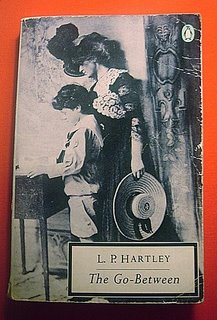
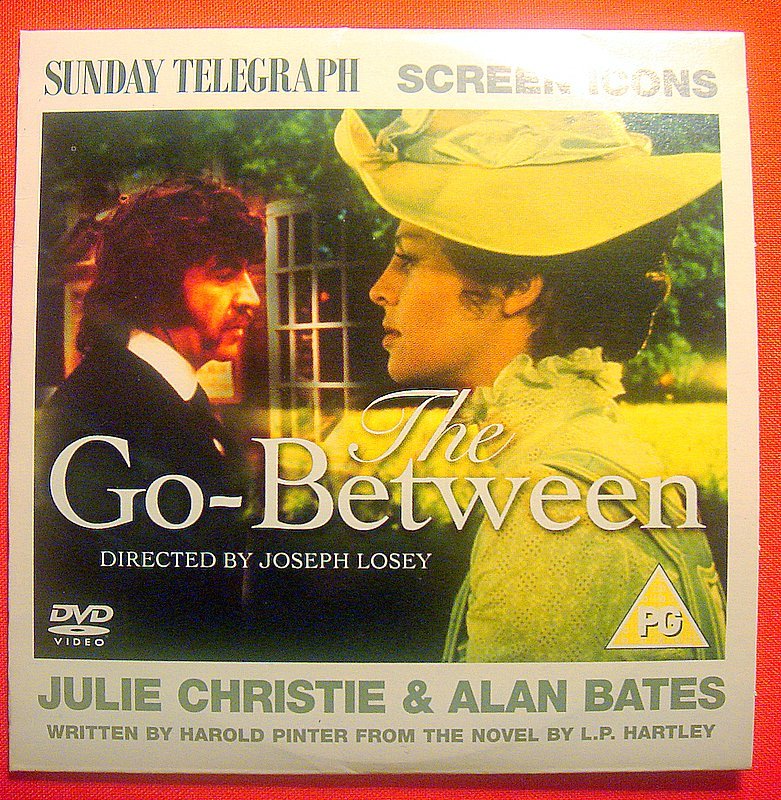
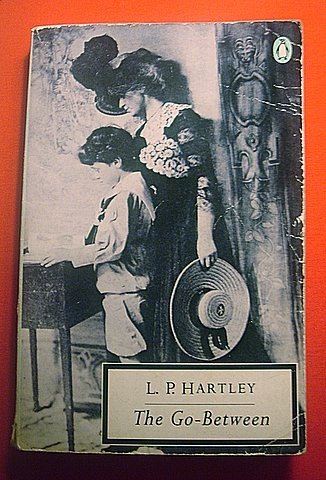
Malinka now and then confesses herself lacking in stamina to find the ideal next book to read and asks for my help. Her usual technique is to shout from the library-corridor the name of an interesting looking book. I answer back with carefully chosen two-syllables expressions like "Hmm-Noops!", "Hmmm..Good", "Forgerit", "Tooboring" and "Didnlykit". A couple of weeks ago she shouts "What about The Go Between"?. "Nothing is ever a lady's fault " - I reply. "What?" "Past is a foreign country, they do things differently there" - I insist. She emerges in my room with the paperback in her hands. "I guess it's worth reading, then..". I tell her that the book, by L.P. (Leslie Poles!) Hartley was turned into one of my all-time favourite films.. The colours of long English Summer afternoons.. A simple but unforgettable theme music one tried to play on the out-of-tune piano.. And there were big names involved too.. Joseph Losey,the Cannes-laureate Director... Harold Pinter the Nobel-laureate author of the screen-adaptation... And Julie Christie of course. Julie Christie, to die for, in the main role. "Who is Julie Christie?" - asks Malinka. Who is Julie Christie??? Who was the main votive figure of all my generation's adolescent wet-dreams?.. I try to explain that she was even better that Virginia McKenna or Michelle Pfeiffer or Jacqueline Bisset or Charlotte Rampling, although part of that category of out-of-this-world passion-inspiring beauties when in full cinematic lighting and make-up. She had never heard about her . I tell then to my too young "The Go-Between" prospective reader that I will order the film first thing in the morning, so that she can understand what my awe is all about.

Surprise! There is no DVD edition of the film! Fortunately, when I'm about to resign myself to ressuscitate my VHS video player I spot, among the amazon.co.uk order list, a reference to a second-hand DVD in a cardboard pocket. A vivid e-mail correspondence then follows with a pleasant auctioneer which has for sale a free bonus to a Daily Telegraph week-end edition many years ago . Gerald wants to make sure I understand that it's a freebie and that it's not a video, which is the only format released so far by the producers of the film. I thank him for his gallant concern but I was indeed eager to get a DVD, either bootlegged, downloaded or newspaper bonus, I didn't care.

So I waited for Malinka to finish the book and then.. zzzzwaap! Like a white columbine or a a flower bouquet in the palm of a magician, my DVD cardboard envelope appears in my hand out of nowhere. We proceed to spend a nice couple of hours around the film and our own experiences of Summer manors with posh English accented-aborigines .

Now it's maybe the right time to humbly confess that although I had acquired the book with the firm intention to read it - having loved the glorious film - I had not in fact did it so far. I am now engaged in countering that shameful hole in my reading armour. Having already almost finished that task, I'm most pleased to announce to the Right Honourable Reader that, as it happens time and time again, the novel is immensely more rich than an already enormously satisfactory screen-adaptation.

So, let me act as a Go-Between myself, carrying this time a message from the author to the Right Honourable Reader: please be curious about the most "different" and exotic of all places, the most foreign country of them all - your own Past.

Johnny Depp


Glass in hand...


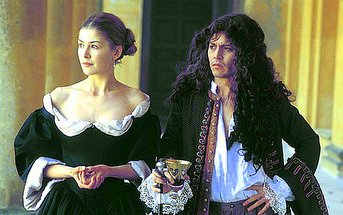
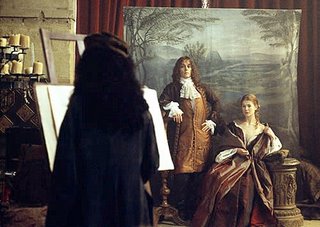
Mr Depp in the role of Lord Rochester, in "The Libertine"


Will the Righ Honourable Reader be bothered with a rhyme by Rochester that involves Catherine of Braganza, Charles II’s Queen? This blogger of yours is unreservedly grateful…

Legend has that the King and the Wits were discussing to find a word which would rhyme with Lisbon, and our Libertine hero managed, almost in one go, to include Catherine (Kate), Lisbon and his pet hate, Edward Hyde, the Earl of Clarendon (the foremost Minister in Charles’ Council) in a satirical attempt. Rochester proposed:

A health to Kate!
Our Sovereign’s mate,
Of the Royal House of Lisbon
But the devil take Hyde
And the bishop beside
Who make her bone his bone

*

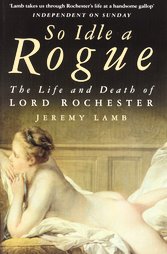
Rochester was of course a drug-addict which brings us to his rock-star type behaviour of quick descent into physical dependency on ever more large doses of drug-intake. His drug was alcohol, still a quite powerful ticket to fast-forward one’s life. Jeremy Lamb’s biography of Rochester deals a lot with alcoholism, to the point of boredom. He stresses though, brilliantly in my view, that much of our Libertine’s whereabouts cannot be separated from the behavioural patterns of an alcoholic. The alternate moods between creative euphoria and self-hating depression, the bursts of violence, both the aphrodisiac and shut-off properties of ethanol, all is very much there.... The film puts it quite well: Rochester always has a glass in hand, a bit like a pro of the diplomatic cocktail circuit (the joke goes that you recognize a diplomat by his arthritis in his right hand.. from holding the ice-cool gin and tonic all his life..) . And the movie puts it quite well too the other major physical affliction of Jay Wilmot: syphilis (fantastic stuff if you want Johnny Depp to have a chance of convincing a forthcoming Oscar jury about his acting performance). http://www.hollywoodjesus.com/movie/libertine/notes.pdf

What we don’t have is a burned-out finale (like Kurt Cobain, Brian Jones or Jim Morrison). He does not OD but has, instead, a rather “silent majority” moralistic end. In his death-bed he turns from atheist into a Catholic, his wife and kids are all around him and he does repent and apologize for his sinful life.. That somewhat surprising decision rises an interesting point: if the impairment of judgement that can be ascribed to a tertiary syphilis brain coupled with all the pathological effects of chronic alcoholism is invoked to justify (that is, attempt at nullify) his bad behaviour, shouldn’t one doubt the mental sanity of his last minute conversion, too?

In any case, it might be interesting to remember that the alter ego of Rochester in Etherege’s play, I mean Dorimant, is not himself a thoroughly radical Don Juan figure. He does not have to face the Commendatore and end up in Hell ( soundtrack by Wolgan Amadeus M.) after repeatedly refusing to repent. Besides, Dorimant and Rochester proper also do not quite carry their utterly ruthless delight in controlling others to the sadistic heights of Valmont or the Marquise de Merteuil. We have here in fact a hybrid. The “rake reformed” pattern plus a “D.Juan”-like biopic. ( For Portuguese consumers only: there is an pious highly-moral equivalent to this hybrid pattern in the figure of Jose Maria Barbosa du Bocage, a XVIII century poet, who also begun as a libertine, a sceptical and a pornographer and ended up conformed and comforted with the Church’s last ointments).


What must surely be stressed in the end is the brilliant quality of Rochester’s writings and the scintillating English of the Restoration play-writers ( Etherege, Wycherley, Dryden, Thomas Otway, the Howards and a few others). Full justice to the supreme wit of their dialogue was done by Stepphen Jeffreys in his modern play (and script). His is a tour de force of bringing to our attention the exceptional life and times of John Wilmot, the 2nd Earl of Rochester.

Thursday, May 04, 2006

Stephen Jeffreys

The 2nd Earl of Rochester: A non-fictional "Restoration" Don Juan...
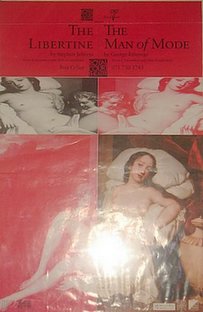


The poster of a double-bill evening at the Royal Court Theatre, circa 1995


As promised, I will try to share with the Right Honourable Reader the logbook of my recent trip into the universe of "The Libertine". What immediately came to my attention when I first got acquainted with my Lord Rochester was the fortunate conjunction of so many kudos or brownies points in my personal table board. Let's check. Relevant historical period (Restoration), importance of Theatre as the art-form of his Times and a rather first class personification of the myth of Don Juan. Bingo!

Let's take on History first. I hope I've made clear for some time now that I believe in a kind of 'quantic' or darwinian evolutionary History whereby more important than a slow chronological flux are some crucial "nodules", historical short periods who have critical mass of data, revolutionary energy and political "pathos" (either drama or tragic-comedy) enough to carry us, - in a quantum-like leap - into new times. The "nodule" Restoration is a very interesting one indeed. When the exiled son of the decapitated king returns to Britain in 1660, as Charles II, an intense and exhilarating unstable chunk of history ensues. For a brief period, not one single ideology, or political movement, or institution of statecraft, or religion apparatus was strong enough in itself to impose its viewpoint or its solutions. People were fed up with the Puritanical party-pooper's zeal of Cromwellian times and welcomed, at least in London, the soft debauche of the restaured monarchy. And the art form which provided the aptest expression of that age was Restoration drama. Theatre as the key to revisit the inner loins of that period ! (as Cinema is doing for these days and ages) To make it a little more appealing to our patriotic eyes we even have a certain Catherine, a Portuguese Queen, kind but moustachoed, sweet and accommodating but ugly as the Sin. Too crude? My apologies. Allow me to proceed.


In each "nodule" there are illuminating biographical case-studies. Among these particular revealing biographies, as code-breakers to certain periods of history, I've always had a fascination for rebellious gentlemen who incurred many risks in order to protect their individual freedoms and beliefs, and who, to top it all, have left beautifully written accounts of their individual struggle. ( Casanova name immediately comes to one's mind whereas the most evident cases in the A-league of English Literature, the only writers that had lived their art to the same degree as Rochester, are Lord Byron and Oscar Wilde)


As for libertine mores, it will not come as a surprise to the Right Honourable Reader if this blogger of yours confesses a certain obsession with the Don Juan myth. Allow me to quote here Prof John Barnard, who edited the play (Etherege's "The Man of Mode") where the main character (Dorimant) is none other but a thinly disguised Lord Rochester :

"Don Juan, the seventeenth-century creation who stands as a naturalist and rationalist antagonist to précieux idealizing of Courtley Love. (Just as Machiavelli's semi-mythic status reflects the emotional and intellectual crisis consequent upon the discovery of Realpolitik in the late sixteenth and seventeenth centuries, and Faustus testifies to the scientific assault on the boundaries of God-given knowledge, Don Juan is a response to related crisis in sexual attitudes). (...) Dorimant is allied to Don Juan and hence to the libertine and skeptical strain in seventeen-century culture, whose most obvious contemporary exemplar was Lord Rochester".

Not everybody's cup of tea? Open to easy attempts at character assassination like this one from Samuel Johnson:

"in a course of drunken gaiety and gross sensuality, with intervals of study perhaps yet more criminal, with an avowed contempt of decency and order, a total disregard to every moral, and a resolute denial of every religious observation, Lord Rochester lived worthless and useless, and blazed out his youth and health in lavish voluptuousness".
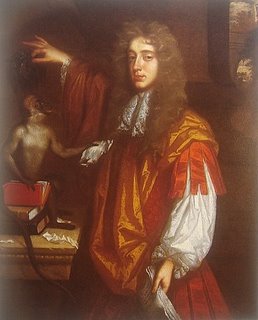
Jacob Huysmans's famous painting at National Portrait Gallery, London

depicting Rochester with a monkey


Is this then what made the figure of John Wilmot so appealing to generate one contemporary play (the already mentioned "The Man of Mode" from his good friend George Etherege, later knighted); inumerous entries in contemporary memorial efforts, including in Pepys' diaries; an extensive list of biographers (from the seventeen-century onwards with metronomical regularity, including, in 1974, from Graham Greene himself - "Lord Rochester's Monkey"; and, as the more recent pinnacle, a modern play, by Stephen Jeffreys ("The Libertine" )http://www.dramaticpublishing.com/jeffreys.html. It was that play which turned into a movie script gave us Johny Depp excelling in the powerful lines of the Prologue:

"Allow me to be frank at the commencement. You will not like me. No, I say you will not. (...) But later when you shag - and you will shag, I shall expect it of you and I will know if you have let me down . I wish you to shag with my homuncular image rattling in your gonads. Feel how it was for me, how it is for me and ponder: Was that shudder the same shudder he sensed? Did he knew something more profound? Or is there some wall of wretchedness that we alll batter with our heads at that shining livelong moment! That is it. That is my prologue, nothing in rhyme, certainly no protestations of modesty, you were not expecting that I trust. I reiterate only for those who have arrived late or were buying oranges or were simply not listening: I am John Wilmot, Second Earl of Rochester and I do not want you to like me."


But we do, my Lord, we do..


(to be continued)

Wednesday, May 03, 2006

John Wilmot, 2nd Earl of Rochester

A Restoration Libertine...


First Johnny Depp.. then Rochester, a Monkey, Nell Gwynn and some more..


There are so many loose ends and black holes on one's understanding of what went on around us that my advice is to stick to that ankle whenever you find yourself biting one. After managing to see Johnny Depp impersonating Lord Rochester in "The Libertine" I've decided to dedicate a full holiday to "further reading" on that subject. I have after all a special sympathy for rogues and wits that indulge in hedonistic pursuits..

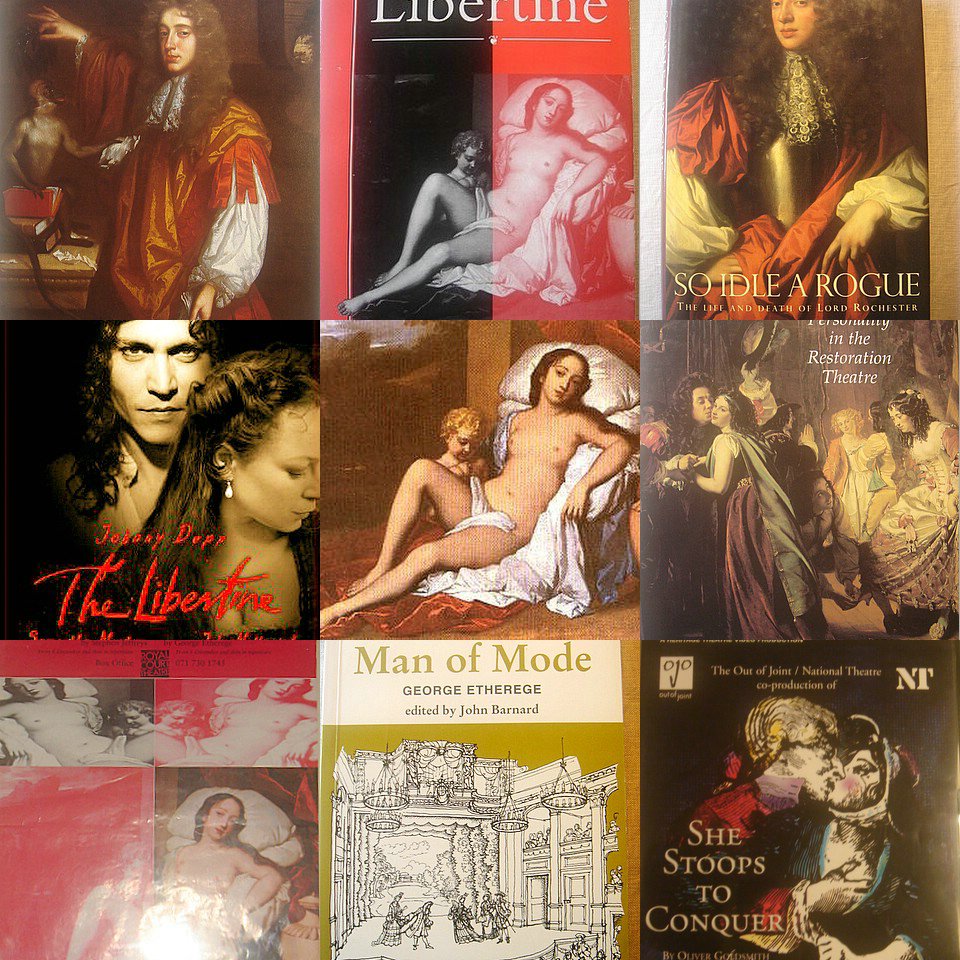
I finally finished re-reading Jeremy Lamb 's biography "So Idle a Rogue - the life and death of Lord Rochester" then; I read Stephen Jeffrey's original play "The Libertine" (which I had seen in the Royal Court in 1995, in a double-whamming program, together with George Etherege 's "The Man of Mode" ); I speed-read the "The Man of Mode" itself (also acquired in Sloane Square in the last century); I managed to find among my books Anthony Master's "The Play of Personality in the Restoration Theatre" bought ten years ago in a Portobello second hand bookshop; and, as a final flourish, I convinced Malinka to have as a post-dinner DVD-viewing "She Stoops to Conquer", a theatrical performance of Oliver Goldsmith's play that resuscitates most of the flair of a Restoration Comedy.

For the benefit of the Right Honourable Reader this blogger of yours intends, in a forthcoming blogtext, to share generously the thoughts and comments evoked by this 10-hours total immersion exercise.
As an appetizer I'll drop a Catullus' quote that could very well resume the moral choices of a libertine:
Odi et amo: quare id faciam, fortasse requiris
Nescio, sed fieri sentio et excrucior
(I hate and I love: why I do so you may well ask
I do not know, but I feel it happen and am in agony)

Thursday, April 27, 2006

H.R.H. Prince Phillip

Name dropping...


( Rats! I should have talked to Her!.. )


Last week Malinka and I were indulging a high-protein supper after the motorway diet of Red Bull and Paprika Pringles. That very same day the photo of Queen Elizabeth was all over the place with the obligatory "Happy Birthday, Your Majesty" splashed in the front pages. Also very big in the news was the inauguration of a Casino in Lisbon, the most recent venture of the Macao-linked Chinese billionaire Stanley Ho. After the excellent red wine, served in successive half-bottles ( Dão Conde Santar 2000, if the Right Honourable Reader is thinking about doing some wine-shopping of his own soon), I proceed to try to embellish as much as possible my own sole encounter with Mr Ho, for Malinka's benefit. After a while, as it has been happening from time to time, Malinka and I agreed that this particular story has the stuff good blogs are made of.
But surely, an anxious Right Honourable Reader is already asking himself, that blogger who claims to be ours is not going to reveal private conversations with third paries, is he? And even involving Royalty? (The tone switching from anxious moral-high-groundish disbelief to incredulous envy-tainted criticism) . The Right Honourable Reader should not worry, though, this blogger of yours will never pursue kiss & tell activities, nothing that will be libelous or defamatory will be divulged in these premices. Simply a matter of something one does not do period.

Nevertheless, one tends to believe that a very short story depicting the episode where this blogger of yours was trying his utmost to impress patriotically H.R.H. the Prince Philip with the size of some wild animals in Portugal can be safely brought to blog light.

Shell I continue? No objections? Good! The story, then.
The dinner had finished, almost drowning with Glory the sparkling dining rooms of the Embassy. A State Visit has a well established routine, and the visiting Head of State always reciprocates the Banquet at Buckingham . ( "Our" own dinner at Buckingham Palace happened the day before and my dashing diplomatic uniform attracted the attention of a rather blue-bloodish celebrity.. but that would be a case of almost kiss and tell all..). This time the Return Banquet had taken place at the Embassy itself; and the topography of the beautiful Belgrave Square building imposed a ground-floor-meal-followed-by-a-first-floor-afterdinner-cigars&drinks routine.
I was upstairs already (not important enough to seat at the U-shaped dining table downstairs I had just finished dinner in the Small Room with some sort of Equerry or Lord-in-Waiting and a few other over-spillers). Guests had started to arrive at the Sitting Rooms, after ascending the very theatrical marble stairs. Princess Diana was one of the first to arrive and she did look around with his gazelle-like eyes, evidently open (either by human curiosity or by the self-discipline imposed on State occasions ) to mingle with the aborigins. This aborigine of yours had no courage to cross the ballroom and declined such portentous encounter with History.
A little later the room started to get filled up with ascending guests, all flushed and in their best moods after the historical Porto Vintage "Quinta do Noval Nacional". Little groups were being formed and getting dismissed shortly after. In one of them I happened to stay standing in front of Prince Philip. Furious at my very recent timidity that had prevented me from sharing some words with the most beautiful woman present (after the Duchess of Kent) I decided not to let go the obvious invitation from Prince Philip to have an aborigine saying something. I made a quick reasoning (in less than a trillionth of a second) and decided to speak of a theme that would amuse the then President of the World Wildlife Fund. I had heard that he had read about or been in the Convent of Mafra, so I opted for mentioning the enormous rats that have been striving in the basements of the huge Monastery for the last couple of centuries. How do you impress a Royal Highness with rats? With the short time available to think, make decisions and talk I calculated that only hyperbole would do. ( As any of my countrymen who have done National Service knows, all the attempts by the military who occupy most of the areas of the Monastery to get rid of the rat infestation are doomed to fail. With the large corridors where to exercise and with plenty of food from the military barracks, the rats had grown heroically in size and numbers. To eradicate them by the usual chemical ways one would have to evacuate the town).
Back to the Sitting Rooms, upstairs, at the Embassy. I follow on the word Mafra and say to Prince Philip. "I am sure you've heard about the rats in the Convent of Mafra. A quarter of a million. And big as cats." His Royal Highness made an interested smile (in my own assessment at the time, the Prince had probably been told the first thing that genuinely interested him during the whole evening). "As big as cats?" - His tone was dream-like with a hint of pleasure.. At that moment SnobsteaksEater, a senior colleague,elbowed me. I was closing the "circle" of people around the Prince and in my enthusiasm I had not noticed that another important guest was trying to join us . I gave way, as they say in The House, and Mr. Stanley Ho (who else?) entered that little schoolyard-like circle. We all went our different ways after that, and I hope no-one has ever told the WWF about the amazing size of the Mafra Convent rats..

Monday, April 17, 2006

Guy Fawkes

A Neo-Machiavelian Neo-Leninist with a fancy mask..


"V for Vendetta", a movie which is trash with a twist...
The Right Honourable Reader will have to excuse this blogger of yours who has been a bit lazy lately. Instead of a full text about "V for Vendetta" I'd rather settle for a quick list of points for further speculation:
- Demonizing Guy Fawkes is part of the anti-Catholic ideological foundation of the modern (post-Henri VIII) English/British State. In constitutional terms the King of the United Kingdom of Great Britain and Northern Ireland cannot be a Roman Catholic. What are the religious views of our political leaders is, in most of our countries, politically irrelevant, but in Britain whenever a public figure is suspected of converting to the RC Church there's a kind of juicy voyeurism attached. ( Most recent examples: was Diana, the Princess of Wales, about to convert? Is Tony Blair attending Catholic Mass?). Ironic then that the hero of the political liberation of Britain from dictatorship - in the film and in the graphic novel it's based upon - is none other than a Guy Fawkes figure.
- Ironic too that one has to blow the Houses of Parliament, the symbol of the sovereignty of the People, in order to regain that same sovereignty. (Fantastic special effects' scene and almost worth the trip to the local cinema) . The original "Papist" plot was to kill the political targets expected to be in the Parliament building while here we have it as a kind of fun fair pyrotechnics to thank the masses for attending the meeting (like in the closing events of marketing-saturated electoral campaigns). Does not make sense.

Tuesday, December 13, 2005

Teddy Bear


Notice the gentlebearly pose of the models on a shop at Claudio Coello...