Showing posts with label Palestine. Show all posts

Saturday, July 21, 2007

Valentino


The best dressed for the occasion was the veiled lady who went for Valentino red...

Eminem


"Capoeira" and Rap at a 'Relais & Chateaux' 5* Hotel...

What would have thought of this Jorge Amado, the writer of the Bahia world,

or Eminem, the rapper of white-trash America?

Barbara Cartland


Not even the feverish imagination of a popular novelist would have come up with this one: a Russian girl from New York marries a Palestinian-British in East Jerusalem and arrives to the wedding by camel...

Tuesday, January 16, 2007

James Baker III

The Unbearable Hardness of the Peace Process...


A two-days conference on "Madrid Fifteen Years Later" at the Intercontinental, in the Castellana. Felt like going back in time, indeed. As Hanan Ashrawi said in her intervention, with a microscopic hint of self-consciousness: "we are older, hopefuly the wiser.. with a certain amount of cynicism .. but still very much engaged and commited to move things further.."
I managed to flash my older, wiser (more cynical) self to a number of carefuly selected attendants, including la Ashrawi herself. Later, back in my office, I flex the muscles of my keyboard-typing fingers, reporting my impressions. Felt good to be back in business.
I realize I'm still very much engaged and commited to move things further.

Tuesday, January 09, 2007

Robert Fisk

Falling for the Middle East thing...


When one compares ones's written notes ( a Journal, rather) with the notes taken at the same epoch by a Middle East Correspondent about the very same portentous issues, some curious vibes are detected.

Having recognized the credibility of his views regarding my own times on that conflict theatre I have to trust him about the period I was no longer there. Like in Fundamental Science, one's objectivity in 'peaceprocessology' is crucial but very hard indeed to keep. You don't have to agree with Fisk's viewpoint at every step of the way but you can recognize an honest atempt at objectivity when you see one. A clearly commendable book.

Wednesday, November 22, 2006

Edward Said

Ramallah Diaries in all sorts and shapes...
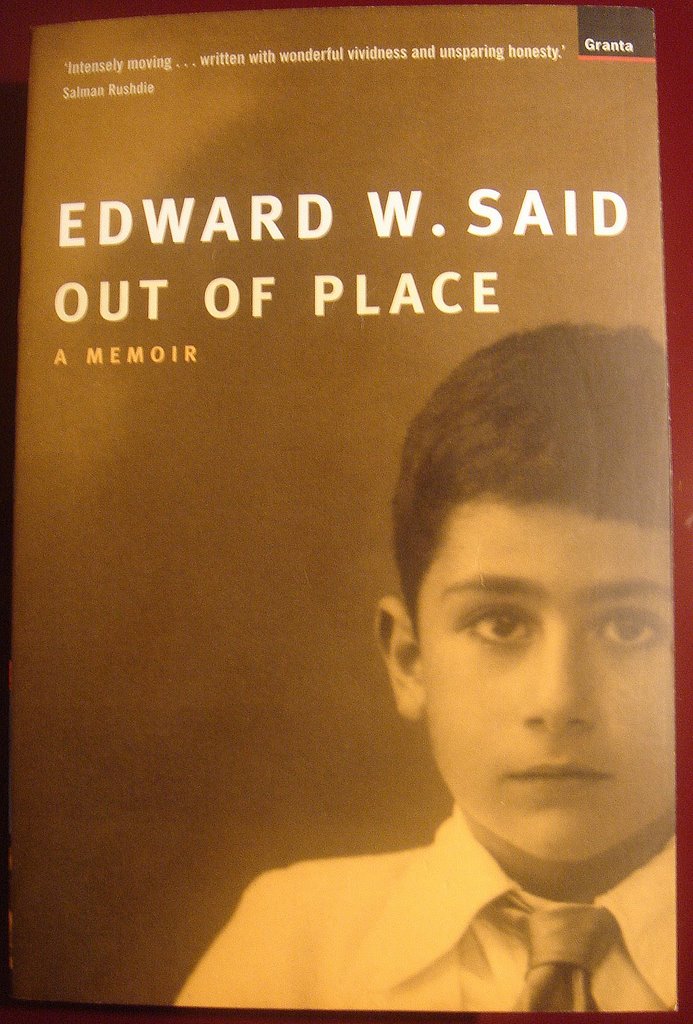


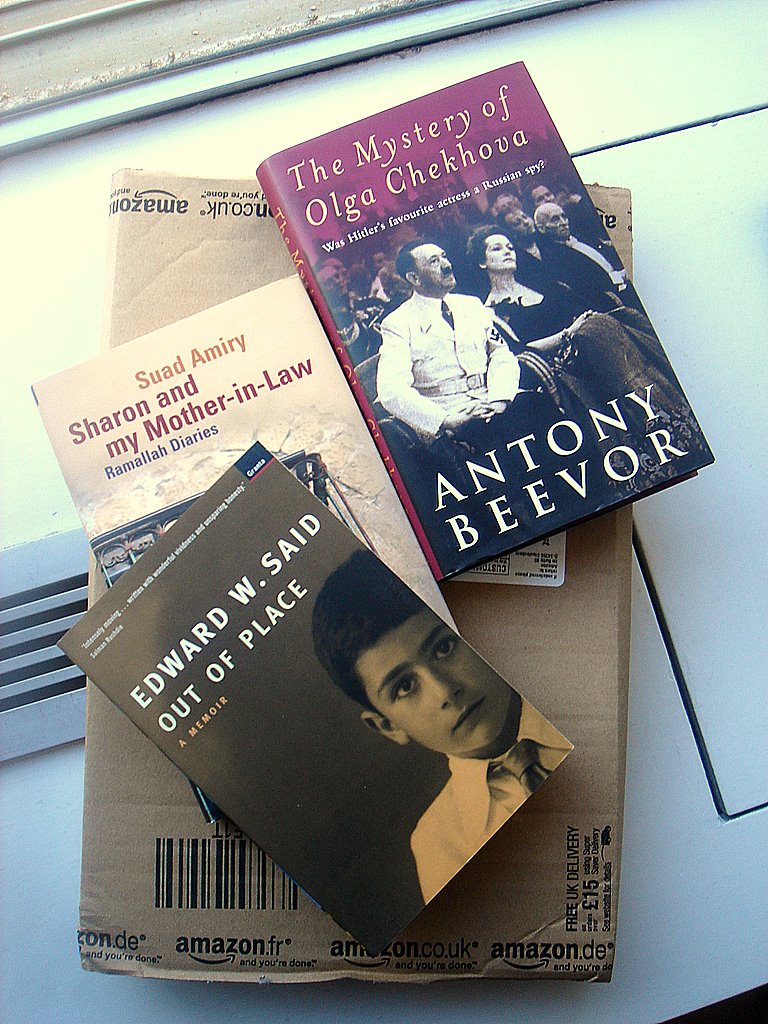
"Out of Place - A Memoir" by Edward Said. If one has to read one non-fiction book about Arab-British P-2-P (people to people) interaction in pre-1948 Palestine, this is the one. The Proustian-like recalling of school days is a very powerful sub-genre of quasi-biographycal literature. If done with honesty and frankness it's like a psychoanalitical key to the author's positions and ideology. Not that what we are or what we defend is a crude result of our chidhood troubles as seen through the spectacles of Professor Freud . But it helps to explain (to ourselves and to third parties) some of the emphasis we choose to put in our discourse. The emotional underscoring, so to speak, of one's political bettings.

I read Said's auto-bio back to back with another book (" Sharon And My Mother-in-Law - Ramallah Diaries") by another American-educated Palestinian, this time centered on Ramallah during the the Second Intifada. Ms Suad Amiry is an eloquent example of the smiling gentle hard-nut toughness of women who have to deal with politics. This blogger of yours is a social machista by geographical birth but a born-again political feminist after experiencing how crucial the contribution of women can be in changing things and societies for the better..

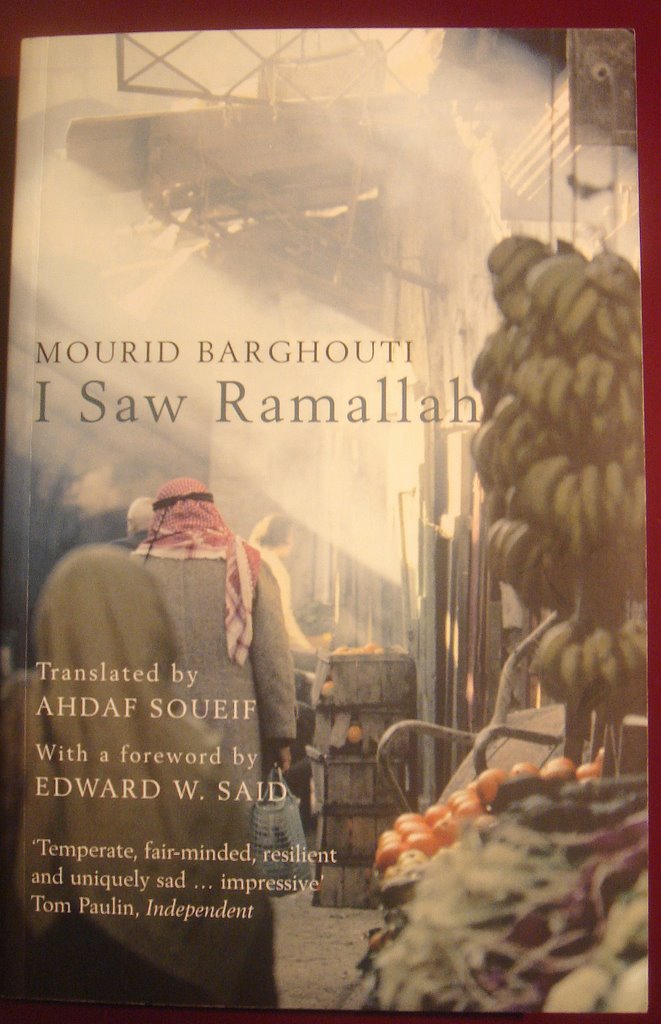
That takes me to a third book, "I Saw Ramallah" by Mourid Barghhouti, about which I've blogtexted about last year. http://praiagrande.blogspot.com/2005/05/mourid-barghouti.html


A nice Tercet of Palestinian Chamber Literary-Music...
Monday, November 13, 2006

Olga Chekhova


With amazon.co.uk everyday can be Xmas...


Delivered this morning, fresh from the on-line bookshop...

Posted by Picasa

Wednesday, May 10, 2006

David Fromkin

"1922" was a crucial historical "nodule" ...


There’s too much information out there. Better to stick to a few areas, and among them to a few themes, and then, alright, be thorough, be deep.

Malinka liked my “nodules” concept for a crash course on world history and wants me to elaborate on that. I longed for a similar request from the Right Honourable Reader but to no avail.

To acquire historical knowledge from A to Z is rather tiresome if not physically impossible (considering the average life expectancy of the Homo sapiens). Instead of starting with the Neanderthal, progressing to Oriental and Classical Antiquity, and from there to the European heirs of Rome until this day and age of evil-axis metaphors and near-non-Nonproliferators an alternative methodology might be on order. Less time-consuming and, intellectually-speaking, much more rewarding.

All bores quote themselves and I will have to conform with norm: “I believe in a kind of 'quanta' or Darwinian evolutionary History. More important than a slow chronological flux are some crucial "nodules". I mean by that historical short periods which have critical mass of data, revolutionary energy and political "pathos" (either drama or tragic-comedy) enough to carry us - in a quantum-like leap - into new times.”


I have also bored stiff the Right Honourable Reader enough times already with some of my favourite A-list “nodules”. A good example is the Russian Revolution one, which I could label, to simplify, “1917”. If one tries hard to understand “1917” almost every single political development in XX Century, from Marx to Fukuyama, becomes intelligible. Worth some studying then.


What other “nodules” in the Rosary of History are worth a particular investment, bearing in mind one’s scarce resources of Time, Intelligence and energy? As it is impossible to achieve wisdom on every significant crossroad of the History of men, each one of us chooses personally a couple of “nodules” to occupy his free moments of an otherwise full-agenda hyper-busy day-to-day life.

Those choices are sometimes dictated by professional interest. When I was trying to figure out, while watching successive sunsets in Jaffa, what was the Israeli-Arab conflict all about, I had to concentrate in “1922” (the Versailles arrangement for a semi post-colonial Middle East). For that Professor Fromkin's book (depicted above) was outstanding. I obviously had also to dive into “1948-69-73" and in “1956” too (yes, the demise of British Imperial Power in Suez is a nodule worth studying.. ).

Some times our choices are just guided by our patriotic personal inclinations. A Christian, in a way, is always returning to the nodule “1 to 33 A.D.”.. A French nostalgic of Napoleonic Imperial Grandeur to “1812” – and to achieve full understanding of Waterloo he will have to end up, as all Frenchmen do, in “1789”.. In the westernmost Peninsula of Europe where I was born, “1492” and “1500, plus or minus a couple of decades” are still obsessively revisited.

Some choices for “nodular” historical research are biography-led, though. As I blogged about recently (boring self-quoting activity again): “In each “nodule” there are illuminating biographical case-studies. Among these particular revealing biographies, as code-breakers to certain periods of history, I’ve always had a fascination for gentlemen who incurred in many risks to protect their individual freedoms and beliefs (…) “ . What produces a Free Spirit? What is so precious about Individual Freedom that turns the rise of Freedom in Society into an almost secondary phenomenon? What makes one admire an atheist among a bigot religious society, or a believer in an atheistic regime, more than the glorious struggle of the Masses? Why would one rather fall for Casanova than for Marx? Why will one always tend to prefer Pasternak to Gorky? And what contributes more to the loosen up of strict hypocritical sexual morals, a rebellious serial seducer like Lord Rochester or the Kinsley Report?

- Will this do, Madam?

Friday, January 27, 2006

Izzedine al Qassam

In Lebanon too, "never a dull moment"..

Hamas activists before 24/1

It's true that this blogger of yours once spend part of his professional curiosity around English-speaking pro-Islamist Palestinian personalities in Gaza; it's also true that this blogger has attended the inaugural session of the Palestinian National Council in the parliamentary premises of Gaza City - but it only means my personal mental data bank does contain images taken in loco by my then non-Alzheymerish brain that react with the word "Hamas" in a peculiar way.
I've been reading comments and analysis from every possible medium and viewpoint about the meaning of Hamas victory and I'm sure the Honourable Reader might be fed up at this juncture with the spin-doctorship of the media and political academia. So I'll stick to my gut reactions, the immediate mental associations triggered by hearing the news that Hamas was about to landslide the parliamentary elections in Palestine.
First flash: (curiously enough) Algeria. What was about to happen if the Algiers regime had not prevented the second round of those key elections to take place (which would have carried the victory of FIS) is now for real: a "green" regime (of Islamists, not environmentalists).
Second flash: "Someone order Democracy? There you have it, Sir. " Too late for realpolitik reasoning now, the votes have already been cast and counted. Surprising results in free and fair elections are the real hallmark of a democratic choice. We'll have to live with it. And worth to remember that there have been no true surprising results before in Arab world's carefully managed elections.
Third flash: Sean Feinn/IRA; Batasuna/ETA; Hamas/Izzedin al~Qassam all over again. How can one deal with a political entity closely linked with a armed/terrorist wing?
Fourth flash: the black-dressed "Haredim" ( Ultra-orthodox Jews) in Jerusalem. They will feel right now more at ease than most in the Land of Israel.. Long-long term projects, and not political short-termism, are the conceptual framework of both "blacks" and "greens"..
Arik Sharon's political death.. Fatah's political collapse... Bibi's incoming political resurrection... - the curse of the "never a dull moment" very much at work in poor old Holy Land...


Tuesday, July 26, 2005

Samuel P. Huntington


Clash of Civilizations?


Moscow, summer 2004 Posted by Picasa


In the current times it's difficult to poke intellectual fun and throw verbal projectiles (as I used to do) at Professor Samuel Huntington's much derided article in "Foreign Affairs" in 1963. Our only hope is there's still some tolerance and sense of humour out there. Last year I went to a magazine annual party in Moscow where one of the rock bands (with partially Central Asian roots) had the guitar-player depicted in the photo as their lead singer. Can't remember her name but she was good.


ps. In case you want to refresh your memory about Uncle Samuel's near apocalyptic scenario:


The Clash of Civilizations?
Samuel P. Huntington
From Foreign Affairs, Summer 1993
Article preview: first 500 of 9,176 words total.


Summary: World politics is entering a new phase, in which the great divisions among humankind and the dominating source of international conflict will be cultural. Civilizations-the highest cultural groupings of people-are differentiated from each other by religion, history, language and tradition. These divisions are deep and increasing in importance. From Yugoslavia to the Middle East to Central Asia, the fault lines of civilizations are the battle lines of the future. In this emerging era of cultural conflict the United States must forge alliances with similar cultures and spread its values wherever possible. With alien civilizations the West must be accommodating if possible, but confrontational if necessary. In the final analysis, however, all civilizations will have to learn to tolerate each other.

THE NEXT PATTERN OF CONFLICT

World politics is entering a new phase, and intellectuals have not hesitated to proliferate visions of what it will be-the end of history, the return of traditional rivalries between nation states, and the decline of the nation state from the conflicting pulls of tribalism and globalism, among others. Each of these visions catches aspects of the emerging reality. Yet they all miss a crucial, indeed a central, aspect of what global politics is likely to be in the coming years.
It is my hypothesis that the fundamental source of conflict in this new world will not be primarily ideological or primarily economic. The great divisions among humankind and the dominating source of conflict will be cultural. Nation states will remain the most powerful actors in world affairs, but the principal conflicts of global politics will occur between nations and groups of different civilizations. The clash of civilizations will dominate global politics. The fault lines between civilizations will be the battle lines of the future. (...)