Showing posts with label Venice. Show all posts

Thursday, November 23, 2006

Isabella Steward Gardner

We will always have Venice...
The book on Bostonian-Venitians...

Prompted by the magnificent painting currently in Thyssen's "Sargent-Sorolla" temporary exhibition I decided to refresh my brain data-bank on the Palazzo Barbaro, Gran Canale, Venice. Apart from Barbaro-related Henry James's books ("The Wings of the Dove"; "The Aspern Papers", the "Letters from PalazzoBarbaro") it's Sargent's painting of the Curtises in their Venetian grand domesticity that evokes the best that bygone era. After a quick Amazon.co.uk research, some electronic flashing of one's visa card and the traditional half week of mail-waiting, I got a brand new copy of "Gondola Days - Isabella Steward Gardner and Palazzo Barbaro Circle". In fact the catalogue for the exhibition Russkaya and this blogger of yours visited last winter during the engaging-ring trip to Venice.

Bottom-line: one should allways try to progress from connoiseur to antiques collector and then to founding patron of a private museum.

On that coffee-table book you can find a remarkable example of one tridimensional space converted, in successive atempts, into a two-dimensional image, both in photography and paintings. The State Room, so to speak, of the Palazzo - the Salone or Cameron, to use its correct designations - has been photographed in 1888 ten years before John Singer Sargent finished "A Venetian Interior".

So the following photo can be seen as the starting point of our visual inquire:

Unknown. The Curtis family in the Salone ofthe Palazzo Barbaro ca. 1888. Gelatin silver print. Private Collection.

Now, let's see four different view-points on that very same room. Clock-wise: a recent colour photography; Water Gay 's 1902 oil painting; B&W photo of the Cameron (with paintings by Sebastiano Ricci and Giambatista Piazetta); and Sargent's masterpiece of 1898.
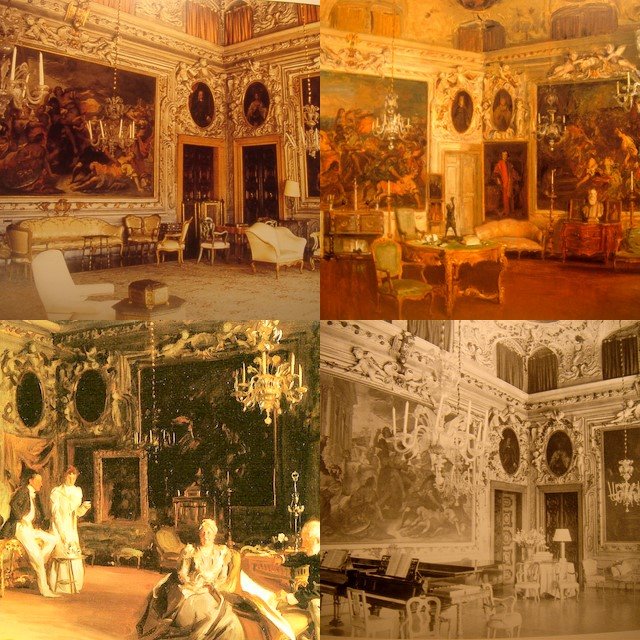
Does not the Right Honourable Reader feel a overwhelming urge to depart for Venice? .. I thought so..

Saturday, November 11, 2006

John Singer Sargent

Sargent: the Quiet American in European Art...


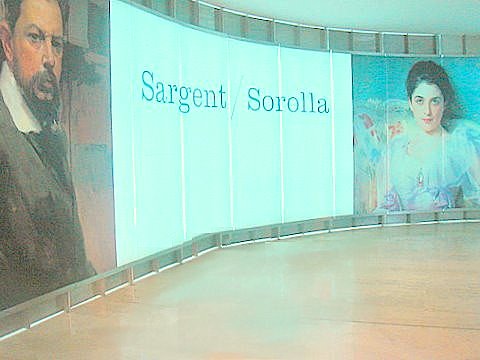
The elegant entrance to the Thyssen exhibition...


The Sargent/Sorolla exibition at the Thyssen (and at Fundacion Caja Madrid) is a must. Two outsiders to the dominant artistic establishment struggling to acquire status. Sargent had to poodle Mrs Curtis at the Palazzo Barbaro, in Venice. Sorolla had to paint folk depictions of Spanish provinces for an American millionaire. Their talent, their strenghts and their shortcomings come very much to light in this curatorial one-on-one. Great stuff..
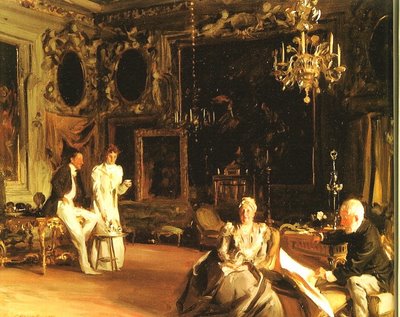
My favorite, from the Sargents at the Thyssen is precisely the one depicting the grand domesticity of the Curtises in the piano nobile of their own private palazzo:


John Singer Sargent, A Venetian Interior, 1898. Oil on Canvas, Royal Academy of Arts, London

Friday, September 22, 2006

Ernest Hemingway


Strategy vs Tactics


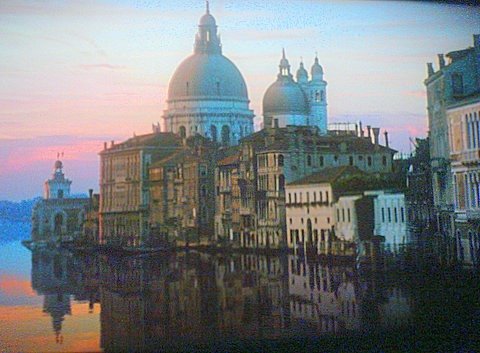
Two friends had agreed to meet for a drink after the long summer vacations. Where to go? In the end to the "Bar Inglês" of the Hotel Wellington. Renowned for being the hotel of the toreros during the Feria de San Isidro, the Wellington has all the charm of a decaying beauty. A bit like Venice, say. The two friends found themselves with large glasses of water in their hands. Only it was not water but ice-cold gin. They call it Dry Martini or some other fancy name. Venice and the generous drinks reminded one of a scene out of Hemingway's "Across the River and into the Trees". Tough-guy posturing but under the thick skins hopeless romantics. Harry's Bar /English Bar. The ghosts of two different types of women were in attendance. When you think of it both the character Renata in that novel (Papa's infatuation with Adrian Ivancich) and the " A Farewell to Arms" character Catherine (about Hemingway's relationship with Agnes von Kurowski in IWW) .

One of the friends, after listening to an elaborate argument about long-term marriages in the old days versus short-term relationships in the current ages, shouts:

"Right! That is it! Women in those times were masters in thinking strategically. Nowadays it's all about tactics".

The two friends went home drunk but with a renewed wisdom.

Monday, April 17, 2006

Giaccomo Casanova

An Hero for Our Times?

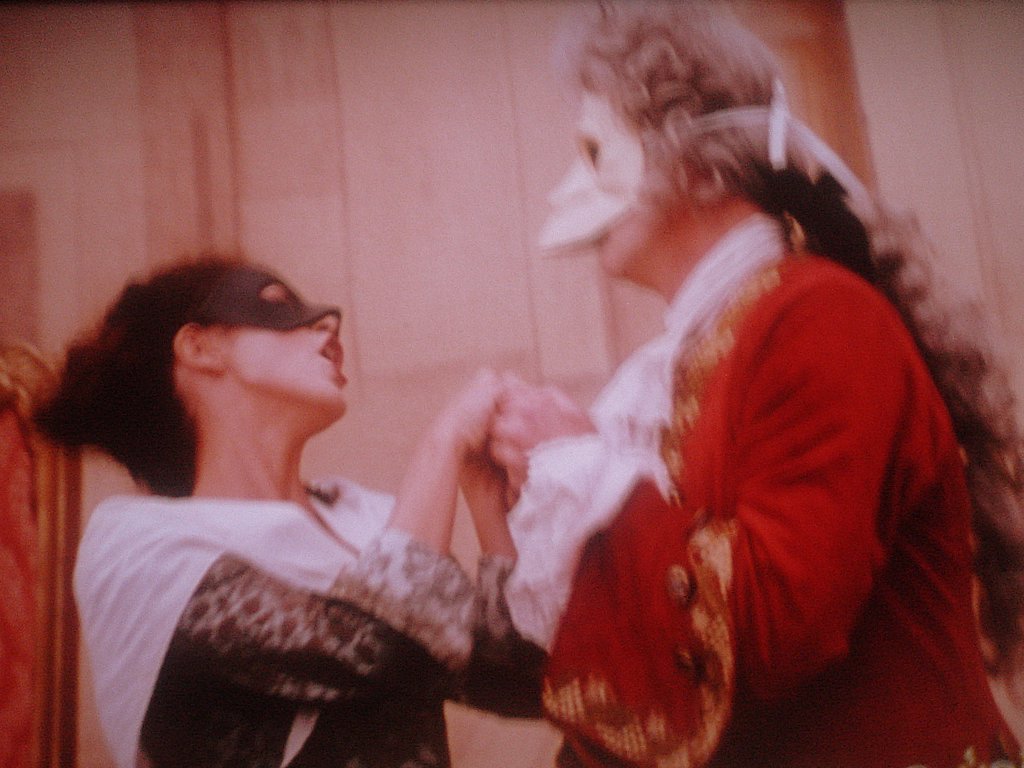
The latest movie product of Casanova Industries Inc. ..

The latest film starring Casanova, by Lasse Hallstrom, was another attempt at convincing us that if only Giaccomo had been able to pursue his supposed true love his polygamous serial infidelity would have ended. In the most recent BBC series it was Henriette who could have performed that miraculous rehabilitation of Casanova, in this film the therapeutic role belongs to a Francesa Bruni, a hyper-clever feminist with good looks (a kind of XVIII century Naomi Wolfe). Does that do justice to the "historical" Casanova, the one we know from his "Histoire de Ma Vie"? It does not really matter. The more "approaches", the more twisted angles that serve as pretexts to re-visit the archetype of the Free Man, the better. He is the true scapegoat of our times. According to many, if divorces figures are what they are, if men prefer pollinating to committing, if seduction has such a luciferous fame - it all comes to the unrestrained anti-social pleasure-seeking Casanovesque behaviour of most men when left to fend for themselves in the real sexual world. So, one as to turn him either into a pathetic figure (like Fellini has done, possibly out of Middle-Italy envy for Venetians) or into a morally-acceptable flawed character capable of redemption if only... Enjoy.