Friday, September 23, 2005

Sienna Miller

Where art thou my sweet Rosalind?
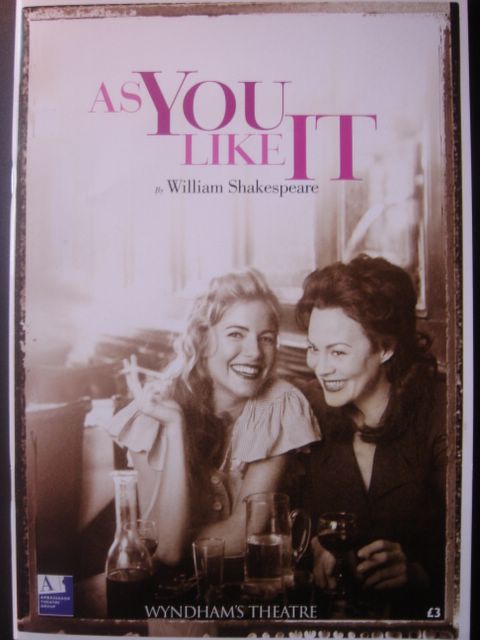
Ms. Sienna Miller and Ms. Helen McCrory Posted by Picasa


I'm afraid I'll have to bother the Honourable Reader with another go at my West End soirée. I should start by saying that Ms McCrory as Rosalind was very impressive but I could not help keeping reminding her as Anna Karenina (in a DVDized mini-series). There were almost "Russian" hysterical desperate traits in her Rosalind that I'm not that sure that it's either justifiable in Tudor comedy or in 1940's France (this production's choice).

Anyway, I want to share with you the latest developments on the "Bay of Portugal" front.

I had commented, in SparkNotes, upon SonnetCLV's interpretation:


bottomless bay of Portugalposted by Moydroog on 9/22 5:18 AM

I do find it an extremely interesting possibility, totally buying the "whole Atlantic Ocean" scenario, only not sure about the chuckle. In that context, two small reservations : "As You Like It" was written in 1598-99 almost one hundred years after the climax of Portuguese Discoveries (India and Gama 1498; Brazil and Cabral 1500), so the "boasting" about the Atlantic Ocean being a Portuguese pond would have to be an enduring one; on the other hand Portugal lost its independence in 1580, meaning that the author would be making humour at the expense of a fallen and beaten (as a matter of fact quite friendly to Britain ) man-country. But what I have more difficulty with is emotions-related - when Rosalind is trying to describe the depth of her love (almost with the bitter-sweet suffering nostalgia in the moment of remembering her love that we Portuguese call "saudade") would she have conjured an image that makes people laugh? W.S. could of course do it (playing in the "chaud froid" effect of antithetical emotions ) but as to Rosalind I doubt it.


Now, unrelenting, SonnetCLV has answered back:


the bay of Portugal posted by SONNETCLV on 9/22 12:47 PM

You make good arguments to defend your position, which may be proper. I would have used the same arguments to rattle my proposition. But in the absence of an actual "bay of Portugal" and based upon the documentation of ships such as the Tyger which were "lost" in the "bay of Portugal" while on their way to Virginia by way of the Canary Islands, one can surmise that the Atlantic was indeed this very bay.
Could the memory have endured for a number of years? Certainly. The year 1498 was not so far away from Shakespeare's era and the time of As You Like It. The documents that did exist were few in comparison to today's glut of information, and so everyone shared what information there was. Too, as I am witness to here in my own country, the memory of prejudices lives long. It should not be unusual for an Englishman of Shakespeare's time to refer to the Atlantic as Portugal's pond, had this been an expression from former times. One thing Elizabethan England could boast of was its spirit of nationalism. Few Englishmen, probably, sad though it may be, cared much about what happened elsewhere in the world. The kind of empathy we're used to today was hardly part of an age that could, for instance, condemn and burn witches, physicists, and Bible translators for heresy. Portugal, after all, did not share Elizabeth's religious persuasion. That alone could keep any old jokes alive and well.
Remember that the expression "bay of Portugal" might well have been an English invention in the first place. ThePortuguesee themselves may never have used it. I have not read anyPortuguesee sailing documents of the era, so I cannot attest to what terms were or were not used. But the term shows up in English papers, and it may have been used derogatorily by a people who took great pride in their own advances as a sea power.
The analysis of Rosalind's motivations within the context of her character prove more problematic. You're right to question whether Ros would make such a joke to Celia in the context of her profession of love. She is a wit, to be sure, and she is a braod ranging personality. But one must also consider that her words are from the playwright, and the playwright often plays with his character's words to put in mouths things for the audience's sake. I'm convinced that Shakespeare's characters often do not know the fullest meaning of what they say. They can only speak from the context of their own world.
But Shakesepare and his audience can understand their language from another context -- their own world. Which is why in Macbeth Macbeth can proclaim "Horrible sight" at the very entrance of the spirit king who represents James. Even James did not understand the full implications of the proclamation. Macbeth certainly did not. But Shakespeare, and a privy few in the audience, had to chuckle at this most serious moment in the play, for it is making fun of King James who is, for those Englishmen who hated him, a true "horrible sight." Of course, I'm speculating here. But I am fond of this speculation nonetheless. It makes sense to me, and I do not believe it is "off the wall", as we say. As You Like It is a vast play, as are all of Shakespeare's plays, and it relies heavily upon allusions from a wide range of sources.
Rosalind, Shakespeare's greatest female, is a beloved character who would have captured the hearts of her English audience. That she might perpetrate the "old joke" of the "bay of Portugal" is not something that would alienate her from that audience.
--SONNET CLV--
Any Rosalinds left out there?

Thursday, September 22, 2005

William Shakespeare

The Bottomlessness of Romantic Love...


WestEnding in London... Posted by Picasa


In order to broadened the mind of the Honourable Reader, and for other small reasons one does not want to share with the virtual space's population, this blogger of yours has decided to spend a weekend in London. As usual, Theatre was up there in the top priorities' list.

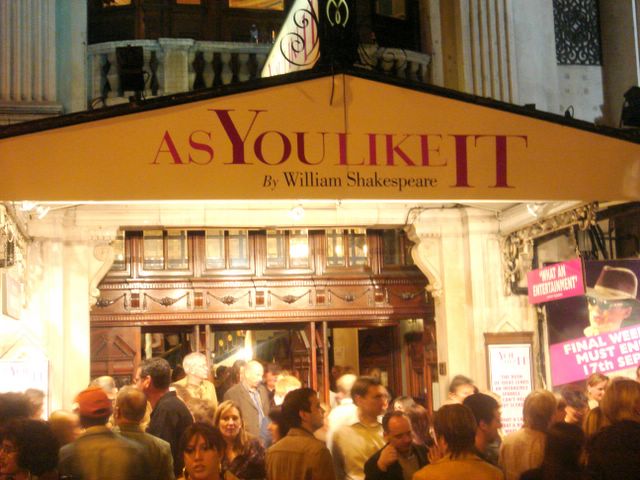
Internet-booked from home, sometime ago, I ended up, to my surprise, attending the final night of the most recent "As You Like It" in the West End, which is in itself a charming thing. (All the staff of the theatre - program sellers, ice-cream-providers, cloakroom girls and good-spirited bartenders included - came to the front rows after the finale, applauding the actors with what looked genuine bonding; Ms. Sienna Miller could not hide her tears - as her first foray into the West End world was coming to an end).

My general state of enchanted beatitude during the performance was pierced by the word "Portugal" on a line from Rosalind in the end of Act IV :

ROSALIND: O coz, coz, coz, my pretty little coz, that thou didst know how many fathom deep I am in love! But it cannot be sounded: my affection hath an unknown bottom, like the bay of Portugal.

Having decided to investigate further this (inexistent) "Bay of Portugal" mistery, my googling efforts were nil. In desperation, I turned to a Barnes & Noble friendly study guides' service called SparkNotes. To log in I had to choose yet another password. This time I used "Moydroog", as a private joke between me and Miss Boots. Finally I was able to put on my enquiry:

The bottomlessness of the bay of Portugal posted by Moydroog on 9/20 5:51 AM

Saw "As you like it" last week in the West End and get acquainted to the line, by Rosalind, "how many fathom deep I am in love! But it cannot be sounded: my affection hath an unknown bottom, like the bay of Portugal.". As Portuguese I would like to know what made WS choose that particular metaphor to bottomlessness (shipwrecks?, common knowledge among mariners?. No amount of googling got me there yet. Any hint?
The following day I got an answer from Clif:
Apparently the Bay of Portugal is unusually deep, and would have been unsoundable by the plumbing methods of Shakespeare's time. But also, there would have been many Portuguese living in England in Shakespeare's time and he surely would have met some of them, and would have been impressed by the emotional depth of Portuguese in general, and especially of the women, in matters of the heart.
How about that?!
Well, I thought I had enough material for my blogpost on this "As You Like It" and I had already started to pen-push it when I had a "breaking news" e-mail alert from Gmail telling me someone else had SparkNoted me. Bingo!
That's what SonnetCLV wrote:
Where, exactly, is the Bay of Portugal? I was prompted by this query to re-read Scene 1 of Act IV of As You Like It, still my favorite Shakespeare comedy (and one which I've had the pleasure to both direct and act in, on separate occasions). I found the quotation near the end of this delightful scene, a scene which features my favorite line in the play, a line again spoken by the inimitable Rosalind: "Men have died from time to time, and worms have eaten them, but not for love." Rosalind is a wit, and IV,1 reveals her wit to its highest nature. Even when the comedy shifts to the more serious tone at the end of the scene, instigated by Orlando's exit and Celia's comment to Rosalind "You have simply misused our sex in your loveprate," Rosalind maintains her wit. She can say of Cupid: "...that same wicked bastard of Venus that was begot of thought, conceived of spleen, and born of madness, that blind rascally boy that abuses every one's eyes because his own are out -- let him be judge how deep I am in love." Yet, she immediately adds: "... I cannot be out of the sight of Orlando. I'll go find a shadow, and sigh till he come." I present this rather antithetical nature of Rosalind to demonstrate that it is difficult to determine if she is serious or punning when she says to Celia: "My affection hath an unknown bottom, like the Bay of Portugal." I take the first part of her remark as the serious, but the second part I see as a sort of snipe against the Portugese themselves. Which brings me to ponder: where and what is the bay of Portugal? Is there such a place? Or was Shakespeare thinking of something altogether different? Did Shakespeare's audience get a chuckle from the line? I think so. Relations between Portugal and England had its ups and downs through the English Tudor years. At one time allies, the two countries ended in disputes when Spain conquered Portugal. Spain remained no strong friend to Elizabethan England. The battle of the Spanish Armada says much. But what of Portugal? Portugal had long been a leader in exploration of the seas. Since the days of Vasco de Gama, the Portugese led exploration. They were commanders of the sea, stronger than both Spain and England when at their strongest. Portugal ruled the waves. Shakespeare was a fond reader of the journals that resulted from the various sea farers journeys. We know he made references to the happenings of these journals in various plays. (I believe I once posted at SparkNotes on the topic of the ship the Tiger in the play Macbeth, a post relating to this topic.) Indeed, some scholars speculate that As You Like It is a play themed on new world exploration. (You'll find notes on this very topic on the internet. ) Some of the extant journals from Shakespeare's era make mention of "the bay of Portugal". (You'll find a couple of these on the internet, too.) In any case, where was this bay of Portugal? My own sense is that the English refer to "the bay of Portugal" as a sarcastic term to represent the Atlantic Ocean itself -- the body of water between Portugal and the Canary Islands and Virginia in the New World. I take it as a derogatory term, as if the Portuguese, who indeed were once a major sea power, claimed that the entire Atlantic were their personal bay. If you look at old maps, you'll see that the Portuguese commanded the African and South American coasts. Thus, the waters between them make a sort of great bay. It is very deep, and was unsoundable by any methods Elizabethan seamen had at their disposal. I think Rosalind solicits a chuckle from her English audience when she mentions "the bay of Portugal." The English take the term to mean the Portuguese pretentious claim of the ocean as their own. This idea would fit well with the temperament of Rosalind and the context of her line. In any case, it brings a chuckle to me.
I hope the Honourable Reader might be leaning to agree with me that the Internet is much more than a cheap tool to have access to pornography or a dismal source of unsolicited heavy-junked mail.
As to the fatidic line that started it all, I can only speculate further. When will we find the robotic miniSubmarine-like device equipped with the right type of "sonar" technology that will be able to probe the depths of one's true great love?

Tuesday, September 20, 2005

Salmand Rushdie

Non-Amazondotcom purchasing of books is very much alive...


bookshopping weekend in London Posted by Picasa

Multi-exposure photo-manipulation technology: the just-published newest Houellebecq - where a 40-something has a love affair with a 20-something... ( private joke) - bought at closing time in the FrenchBookshop in SouthKen; the more recent appraisal of Stoppard's output acquired in the delightful bookshop of the National Theatre, at SouthBank; and a couple of hardbacks, including Uncle Salman's latest, as a result of a visit to the much cherished "Waterstone's" at Old Brompton Road..

Stella McCartney

Street drunkards from privileged backgrounds...


Victoria and Albert Museum grounds, London 18th September Posted by Picasa

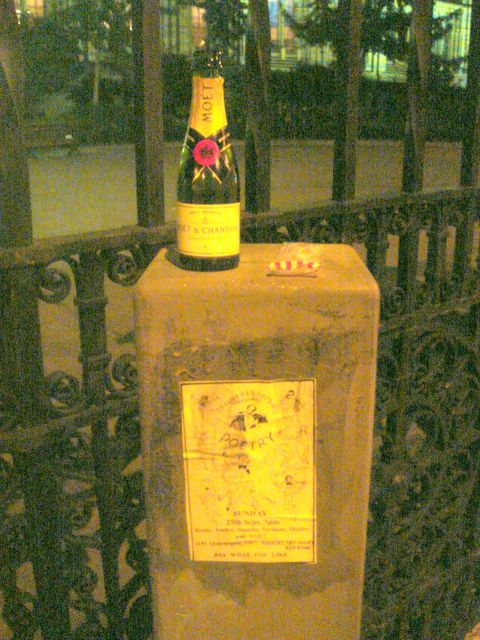
On the eve of London Fashion Week, after a pre-opening event, one could see some evidence of traditional drinks-related rude behaviour.. Only that this time, instead of the usual beer cans littering the street near the pub where your Premiership team has just been trashed by the Blues, you have an un-solicited advertising for Moët & Chandon...

Edward, Prince of Wales

Edwardian Values


Keep Hunting, Shooting, Fishing and Fucking Posted by Picasa

A "Countryside Alliance" pro-Hunting bracelet is the latest fashion accessory for all lovers of bloodsports...

Friday, September 16, 2005

Nancy Mitford

Insider's socio-anthropological view of the upperclass


Upward mobility Posted by Picasa

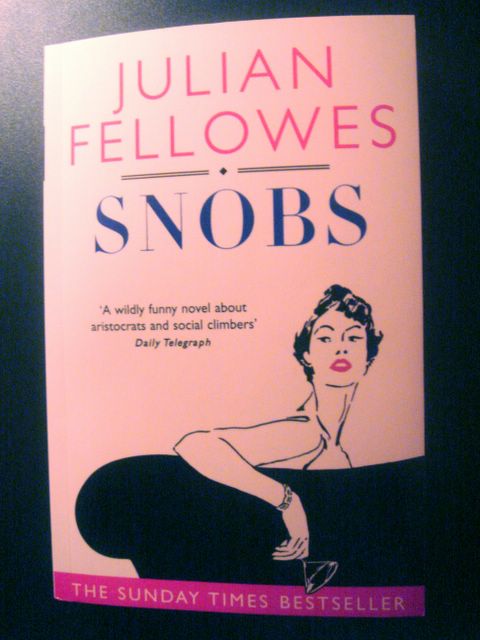
Mr Fellowes - the man who gave us the script of delightful Gosford Park, has written a novel about an endangered species, the aristos who are not yet totally National Trust-dependent. He actually knows people from that rarefied upper-stratum of British society and that insider's knowledge, so to speak, shows. Ms. Nancy Mitford started the genre, I think, and "U and Non-U" is still obligatory reading when you want to laugh at the subtleties that separates greedingly ascending upperclass and land-owning blueblood. It all comes, in the end, to language and accent. (An example of that non-Marxist "class war" literature is Ms Jilly Cooper, of course, but from a below stairs perspective, I'm afraid).
A more serious point is whether the "range" of a writer mirrors his social background or if he can transcend it. Tolstoy has upper nobility characters in his books, and they sound credible, because he was part of that same social set; Dostoevsky never risked going beyond petty nobility, he knew his shortcomings. The spectrum of writing material cannot go too far, in fact. It's frustrating, I know. There goes the fiction that a great writer can bring to live a character from whatever background he chooses.
In Politics something similar happens.You can be a Socialist or a Communist but you'll never be able to "read" well what goes on a Extreme Left mind unless you've been there yourself. The Bourgeois Right cannot understand a practicing Extreme Right skinhead, either. Or, you have to be a former football hooligan in order to write anything meaningful about that phenomenon.
Put it that way, Landowning Aristocrats are extremists.

Thursday, September 15, 2005

Gomes de Amorim


Arab room, upstairs, Sintra 2003Posted by Picasa


Red colour and Sun light, can't ever have enough of it...

Monday, September 12, 2005

Antonio Banderas

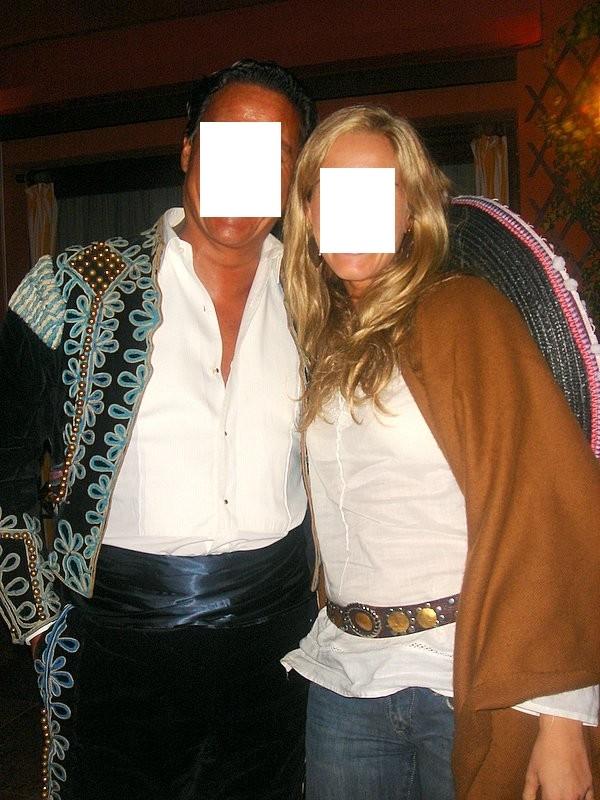
A Mexican party, the best alibi for drinking Margaritas...


Live-Music at the Door of Iron... Posted by Picasa


The Honourable Reader if at all a follower of this humble blog might remember a pleasant lunch by a swiming pool in Puerta de Hierro, reported about last 11 July, posted under "Mark Spitz" title. Well, I returned to that wonderful spot and I am happy to confirm that even at the heart of the serious Imperial capital of Castilla there are fancy parties going on, just like in the British World, albeit in smaller doses. The cosmopolitan couple I mentioned before, Der Ingenieur and Garbo, throw a early post-Summer theme party each year , eagerly attended, and this time the invitation mentioned "Fiesta Mexicana".
I must confess I had something of a dilemma at hands. Should I ignore the implicit request to fancy-dressing myself, should I timidly include some Mexican detail in an otherwise casual chic outfit or should I go all the way, more Mexican than me you die? (A trilemma, rather). The Honourable Reader is quite acquainted with the mechanics of my psyche by this time of this Blog's existence and no doubt guessed that I went for the third option.

After some telephonic research conducted by an efficient member of my staff (at work, not at this Blog, which is a purely one-man show, if one can use this word), a theatrical rent-a-dress joint was found in a slightly seedy part of town (I counted a number of peepshows and erotic establishments walking down the street, on the way back home). A first floor in an delerict building, with Habsburg velvet coats, StarWars helmets and Jacobean wigs, was the almost underworld place where I was told a Mariachi outfit could be found. Evita, the generously bodied Venezuelan assistant wanted me to carry pistols as an essential item to enact a hotblooded Mexican, while a shy-looking member of the public, in town to sing Medieval romanzas, would rather have me gun-less. After some undressing and dressing in a cubicle under fluorescent lights that ruin a 4-weeks Atlantic Coast suntan, I opted for a dark blue velvet outfit I was assured to be used by the most discerning Mariachis. (I suspect it belongs rather to the "Goyesca" family of fancy-dressing but I'm not in the mood to peruse further into Clothes Taxonomy).

A last problem remained. The outfit asks for a wide sash round the waist (like the black satin "cummerbund" on a dinner-jacket) and there was none of it, except for a pitiful sky-blue ersatz. I had, then, to pay a visit to Zorilla, a kind of Madrid's Peter Jones in what regards pieces of cloth for economy-conscious upper class ladies on the hunt for material for their new season dresses. I bravely defied the suspicious looks of a customer eager on Armani-like soft fabrics (at the tenth of the price) and I acquired two meters of dark-blue satin that seemed to do the trick, rolled around my burgeoning belly with a turban-like technique.
A last minor problem to solve were the riding boots. My own were dry as some fins of salted cod forgotten in the backyard of a grocery, so I had to go out again to purchase some horse grease, in order to, with energetic concentration, make it soft and shiny.
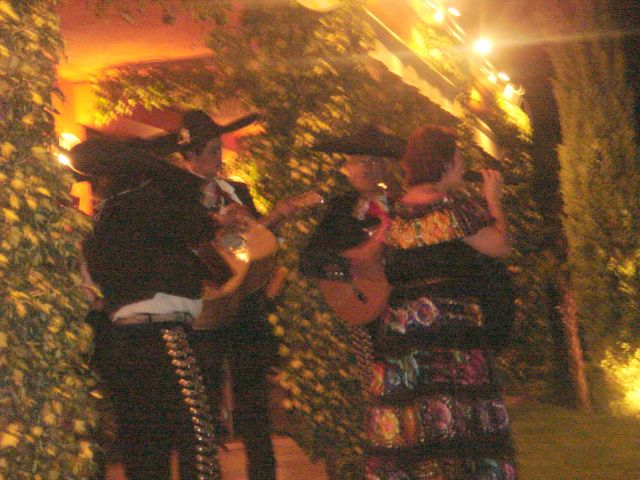
At the party itself, the margaritas were consumed with abandon, and the champagne, under the circumstances, was drunk more in a way of the glasses of water one sometimes have to indulge in to delay the no-return point of acute alcoholism. When, after the real Mariachis, the salsa arrived, I tried to dance with Central-American poise and Iberian furia, but my efforts were somewhat marred by the ever falling bloody "cummerbund"..
I was lucky enough to be seated next to a Roxanna whose blondiness and general good looks comes not from Celtic Asturian blood but from Austro-Hungarian ancestry. That gave the party a spice that one would rather expect in the sauce of the, obviously excellent, Mexican food.
(Note the accessories of the true Mariachi outfit: the satin "cummerbund" and the blonde girl with sombrero (optional) )

Thursday, September 08, 2005

Carlos da Gale

Post-Summer Blues


Praia Grande, 2nd September 2005 Posted by Picasa


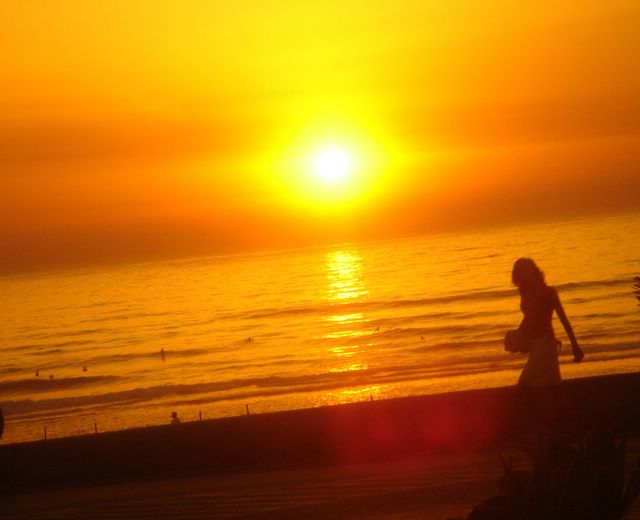
On the water the waiting surfers look like submerged crocodiles. The Green Ray is about to fail us once again. A Girl passes by, with urgent steps. Glasses are scattered around after a missed vigorous toast.

Wednesday, August 03, 2005

Nam June Paik

SMS Conceptual Art ...


JRyder's "Summer Kisses", manipulated digital still, 2005 Posted by Picasa


A eve-of-holidays last drink that does not come off can be turned into Art? - the Honourable Reader might be forgiven for his skepticism.

This is a very Hi-Tech conceptual thing and the Honourable Reader has to bear with me while I go through the crucial technical data here. In the beginning you have a incoming SMS in the screen of a ™Nokia 6300 mobile phone. Then you photograph it with a ™Sony Cybershot DSC-T7 and you transfer the image, thanks to Sony ™Picture imaging software into a portable computer ™Compaq Armada 1750. After checking image quality you store it in a ™MyFlash 1G Memory Stick. You then transfer the 557 KB image to the USB port of a ™Hewlett-Packard mainframe computer, via the Memory Stick, and with ™Microsoft Photo Editor-related ™Paint software you make the last manipulations. Having got your final picture you store it as a ™Picassa file and upload it, through ™Hello software, to the ™Blogger site at http://www.blogger.com/, from where it will be published in your blog.

Old sod McLuhan said it all before: the medium is the message.

Summer kisses to you all!

(Note: Nam June Paik is credited with having "invented" videoart when he used a then new Sony Portapak device to shoot footage of Pope Paul VI's procession through New York City)

Tuesday, August 02, 2005

Balthasar Klossowski de Rola

Pink gown..


Balthus' "Chambre Turque" 1963 (detail) Posted by Picasa


How does one associate (1) painting, (2) depicting a woman and (3) the pink colour? There you are. Ms Setsuko Ideta, in a pink gown.

Velazquez clones

New Spaniards...


From the cover of John Hooper's "The New Spaniards" Posted by Picasa


Iconic imagery always sells well.

Monday, August 01, 2005

Jorge Luis Borges

Fervor de Buenos Aires...


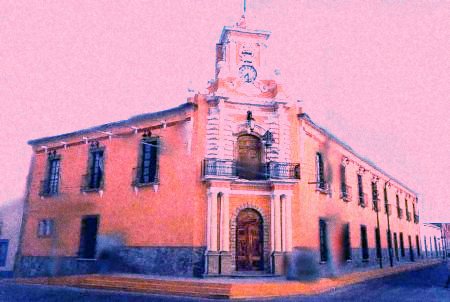
Photo-manipulation of a portal in Mexico to accommodate the subject-matter
"El Hombre de la Esquina Rosada" Posted by Picasa


Just finished a Borge's biography by James Woodall, which I had bought some time ago to add to an already inflated list of books by and about Uncle Georgie. This time I was readier not to loose implicit or more subtle links. Borges lived in Spain, namely in Madrid, in places with names that have now a meaning for me. Argentine national sport of attenuating their Spanish roots and prefering to elaborate on supposedly more glamorous British or French DNA is also better understood now. And I've met a Buenos Aires-born Madrileña that evokes the pinkness of JLB's masterpiece "El Hombre de la Esquina Rosada", one of my long time favorites. Pure love for literature brought me to Borges in my youth; Piazolla took me later on to a second wave of curiosity for any porteño-related stuff; now, embarking on my third journey to Borges's works, I realize that's Buenos Aires what is ticking me this time. I'll blog about it some day.