Wednesday, August 03, 2005

Nam June Paik

SMS Conceptual Art ...


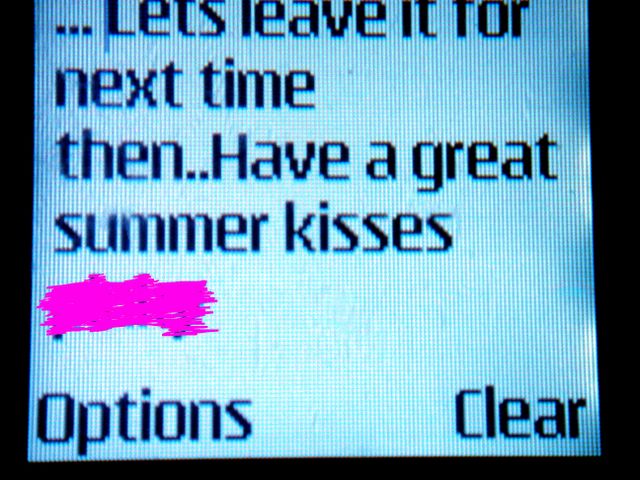
JRyder's "Summer Kisses", manipulated digital still, 2005 Posted by Picasa


A eve-of-holidays last drink that does not come off can be turned into Art? - the Honourable Reader might be forgiven for his skepticism.

This is a very Hi-Tech conceptual thing and the Honourable Reader has to bear with me while I go through the crucial technical data here. In the beginning you have a incoming SMS in the screen of a ™Nokia 6300 mobile phone. Then you photograph it with a ™Sony Cybershot DSC-T7 and you transfer the image, thanks to Sony ™Picture imaging software into a portable computer ™Compaq Armada 1750. After checking image quality you store it in a ™MyFlash 1G Memory Stick. You then transfer the 557 KB image to the USB port of a ™Hewlett-Packard mainframe computer, via the Memory Stick, and with ™Microsoft Photo Editor-related ™Paint software you make the last manipulations. Having got your final picture you store it as a ™Picassa file and upload it, through ™Hello software, to the ™Blogger site at http://www.blogger.com/, from where it will be published in your blog.

Old sod McLuhan said it all before: the medium is the message.

Summer kisses to you all!

(Note: Nam June Paik is credited with having "invented" videoart when he used a then new Sony Portapak device to shoot footage of Pope Paul VI's procession through New York City)

Tuesday, August 02, 2005

Balthasar Klossowski de Rola

Pink gown..


Balthus' "Chambre Turque" 1963 (detail) Posted by Picasa


How does one associate (1) painting, (2) depicting a woman and (3) the pink colour? There you are. Ms Setsuko Ideta, in a pink gown.

Velazquez clones

New Spaniards...


From the cover of John Hooper's "The New Spaniards" Posted by Picasa


Iconic imagery always sells well.

Monday, August 01, 2005

Jorge Luis Borges

Fervor de Buenos Aires...


Photo-manipulation of a portal in Mexico to accommodate the subject-matter
"El Hombre de la Esquina Rosada" Posted by Picasa


Just finished a Borge's biography by James Woodall, which I had bought some time ago to add to an already inflated list of books by and about Uncle Georgie. This time I was readier not to loose implicit or more subtle links. Borges lived in Spain, namely in Madrid, in places with names that have now a meaning for me. Argentine national sport of attenuating their Spanish roots and prefering to elaborate on supposedly more glamorous British or French DNA is also better understood now. And I've met a Buenos Aires-born Madrileña that evokes the pinkness of JLB's masterpiece "El Hombre de la Esquina Rosada", one of my long time favorites. Pure love for literature brought me to Borges in my youth; Piazolla took me later on to a second wave of curiosity for any porteño-related stuff; now, embarking on my third journey to Borges's works, I realize that's Buenos Aires what is ticking me this time. I'll blog about it some day.

Friday, July 29, 2005

Juan Ponce de Léon


Will Miami be the New Madrid?...


Miami-centric Caribe Posted by Picasa

Where lies the cultural traveling heart of an Hispano-American?In the Caribe itself? Longing for the labour market of real-estate bubbling Spain, and therefore Madrid?Dreaming about South Beach condos, instead?


The more I know and talk with people from the Northerner part of South America, particularly when you come across Ibero-Americans from Colombia, Venezuela or with Cuban DNA, the more I realize how Miami is in everybody's minds. From post-Castrist Takeover shelter to a kind of safe haven for earnings at home (to the Bogotá elite, for instance), Miami has become the magnet for the Caribbean elites. In a way, it has become a kind of Metropolis of a new post-imperial system.

To that two further interesting points should be added. On one hand, Miami is becoming more and more Hispanic" , and the rise of importance of the Spanish language there is phenomenal; on the other hand, the migrant fluxes to Spain from Latin American countries (Bolivia, Ecuador and Colombia, in particular) have been awesome (we are talking many hundreds of thousands here). It's almost like a re-arranging of puzzle pieces.

Will what started as a foothold on the (North)American Eldorado end up being the Jewel in the Crown of a new global Spanish-speaking system? (The only Western system that can rival culturally the "Anglo-Saxon" one, as some point out? ).

For local colour, I try to get material from the Miami Correspondent of this blog of yours. What? - the Honorable Reader finds himself exclaiming with sincere admiration - this blogger of yours has a network of correspondents? Well, always interested in improving the service provided to the Honourable Reader, I've decided to enroll some local expertise whenever appropriate. Tosca, whom I had the pleasure to meet in a cigarral off-Toledo some partytime ago ( alluded to in a blogtext entitled Domenikos Theotokopoulos) has been spending in South Beach her well-deserved holidays from a hard working life as a partridge-broker (if you like shooting and want a 'private finca stay and plenty of partridges downed' package, she's the girl to contact). What she tells me about the northamericanization of southernamericans living in Florida is a matter of concern, including that the decibel levels of children behavior and the obese-inducing average size of meals are not the most pleasant features of modern Miami (by the way, the postcard above depicts the yachting area of Miami in Arcadian good old times). There is of course the "new money" dimension to take into account, and some of the local gossip might not be high-cultured.
Tosca, praiagrande.blogspot.com correspondent in Miami, writes: “ Desde que llegué me ha pasado de todo pero te iré contando poco a poco ya que si no, tendrí­a que escribir horas.(...) Estoy impresionada de la gente aquí­ en Miami que es gente en general con poca educación pero con mucho dinero (…). Hay de todo pero sobre todo (…) y lo único que piensan es en el dinero y en las cosas materiales. Las conversaciones giran en torno alo que uno posee: mi carro de 70.000 dólares, mi casa de 2 millones de dólares, mi reloj de 10.000, mi mujer de 100.000 dólares, mi perro de tal marca, enano, reducido y que le ha costado un riñón para que no haga ruido ni ladre, por tanto no es ni un perro pero lo importante es lo que le costó“.

But that does not really matter in the long-term. The relevant issues will become clearer with time. What one wants to know is what kind of cultural fusion meal will result in the end from the dynamism of the US of A mixed with Caribbean energy a la Spanish language sauce ? Madrid, watch out..

Thursday, July 28, 2005

Michael Collins

Taking the bomb out of "the bomb and the ballot-box" strategy...

The British Crown and the Irish Harp
Posted by Picasa
IRA declared the end of its double-faced strategy. No more "arguing" with bombs and guns, as from 17.00 CET the fight for an United Ireland will have to be carried out by strictly non-violent democratic means. Good. (I wonder what Michael Collins, the Irish Nationalist, would have thought of all this?)

Jose Antonio Primo de Rivera


The "Flag of Hispanidade" is X-rated political stuff... Posted by Picasa


This blogger of yours was doing some research on Spanish History, circa Civil War times, and came across a flourished bit of nationalistic prose that one could translate as " the Christian and Imperial heroical sense of the joyous days of our Greatness". Now, how would post-modern text exegesis deal with that?
(In Spanish it reads like this: "(...) sentido heroico cristiano y imperial de los jubilosos dias de nuestra grandeza." )

Wednesday, July 27, 2005

Iosip Deribas / D. José de Ribas

Adventurers, then and now...


The Opera House in Odessa Posted by Picasa


When you least expect there's the irruption of History into your dinner table, just as you are about to enjoy a braised solomillo in an asador in Las Rozas. You try to keep your attention focused, a difficult job because you pretend you are just listening to Don Marchal while at the same time you are in fact keeping an eye on Clairedelune's reactions to the Sea Adventurer's tales. He has just popped up the name of Odessa ("Adessa" as it's pronounced in both Russian and Ukrainian), and that immediately conjures a vortex of images, names, fragments of memory trash. White Guards.. Denikin.. the flight to Constantinople.. the General Prince Gregory Potemkine ("Patiômkin", in Russian) .. Turkish-Russian Wars.. the mutiny aboard Battleship Potemkine.. WWII battles.. my own holidays in Crimea. I gulp the chilled red Rioja, taste the rare steak, check Clairedelune's smile towards Don Marchal but my mind keeps wandering..
I listen with amazement. Don José de Ribas, a Spaniard, founded Odessa?? (The Honourable Reader can find this text somewhat cramped between the portrait of D. José and a contemporaryary photo of a building in Deribasovaskaya Street, Odessa, Ukraine). I heard it well. It was indeed De Ribas, an Adventurer at the service of Catherine II who commanded in 14 September 1789 the Imperial forces who stormed the fortress of Hadjibey. Born in Naples (which had then a Spanish Sovereign), with Catalan aristocratic blood from his father's side and Irish DNA from his mother's, the talented officer was a soldier of fortune, one of the many adventurers pooled by the Empress. His name had been russified in the meantime to Iosip Deribas. In 1795 Hadjibey (or Chadsbey) became Odessa.
Who are the new Adventurers? The Guinness Book of Record-seekers? The opium-consuming Westerners of the High Himalayas who dropped out at the apogee of the Hippy movement? The sleepless Hackers who enter the Pentagon super-computers? The Jihadists who travel to the Afghan-Pakistan Passes for quasi-military training? A manager of a rent-a-soldier business who departs for Africa to start a coup? I think not.
Don Marchal, though, is an Adventurer allright. For years now he has been engaged in sea travel in a rather peculiar way, climaxing in crossing the Atlantic Ocean in his water scooter, and he wants to travel now from De Ribas' Barcelona to Deribasov's Odessa. (I could see that his physical charisma, his exploits, and maybe his implicit rarefied connections, was damaging the solidity of the pseudo-indifference mask of the listening ladies. Just as Ribas stormed the Hadjibey fortress was the Don storming Clairedelune's defences? Now, the Honourable Reader might detect a iota of jealousy here, and he might not be wrong. Alfa males never take it easily that some other fellow is using words that induce tachycardya in beautifully-eyed females. Nothing personal. Something has always to be done to adjust the male hierarchy around the dinner table).
I realized then that a Blogger can also be an Adventurer..

Tuesday, July 26, 2005

Samuel P. Huntington


Clash of Civilizations?


Moscow, summer 2004 Posted by Picasa


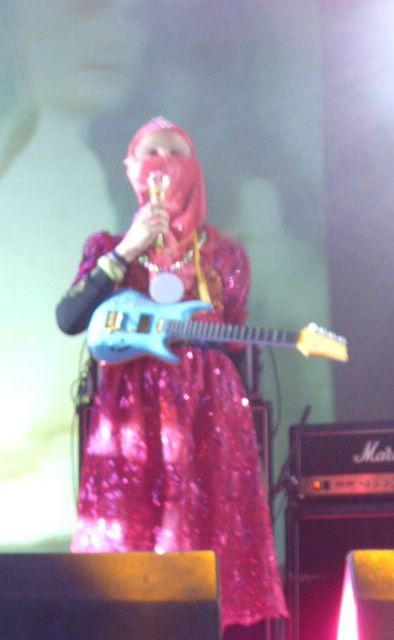
In the current times it's difficult to poke intellectual fun and throw verbal projectiles (as I used to do) at Professor Samuel Huntington's much derided article in "Foreign Affairs" in 1963. Our only hope is there's still some tolerance and sense of humour out there. Last year I went to a magazine annual party in Moscow where one of the rock bands (with partially Central Asian roots) had the guitar-player depicted in the photo as their lead singer. Can't remember her name but she was good.


ps. In case you want to refresh your memory about Uncle Samuel's near apocalyptic scenario:


The Clash of Civilizations?
Samuel P. Huntington
From Foreign Affairs, Summer 1993
Article preview: first 500 of 9,176 words total.


Summary: World politics is entering a new phase, in which the great divisions among humankind and the dominating source of international conflict will be cultural. Civilizations-the highest cultural groupings of people-are differentiated from each other by religion, history, language and tradition. These divisions are deep and increasing in importance. From Yugoslavia to the Middle East to Central Asia, the fault lines of civilizations are the battle lines of the future. In this emerging era of cultural conflict the United States must forge alliances with similar cultures and spread its values wherever possible. With alien civilizations the West must be accommodating if possible, but confrontational if necessary. In the final analysis, however, all civilizations will have to learn to tolerate each other.

THE NEXT PATTERN OF CONFLICT

World politics is entering a new phase, and intellectuals have not hesitated to proliferate visions of what it will be-the end of history, the return of traditional rivalries between nation states, and the decline of the nation state from the conflicting pulls of tribalism and globalism, among others. Each of these visions catches aspects of the emerging reality. Yet they all miss a crucial, indeed a central, aspect of what global politics is likely to be in the coming years.
It is my hypothesis that the fundamental source of conflict in this new world will not be primarily ideological or primarily economic. The great divisions among humankind and the dominating source of conflict will be cultural. Nation states will remain the most powerful actors in world affairs, but the principal conflicts of global politics will occur between nations and groups of different civilizations. The clash of civilizations will dominate global politics. The fault lines between civilizations will be the battle lines of the future. (...)

Ilya Ilich Oblomov

The attraction of a life staying forever in bed...


Posted by Picasa Pictures from Mikhalkov's film plus P.A. Fedotov’s “The Aristocrat at Breakfast”
(Tretyakov Gallery, Moscow)


True heroes tend to be universal, the Honourable Reader might be tempted to agree, but some are more universal than others. The central character of Ivan Aleksandrovitch Goncharov’s one and only masterpiece is the universal archetype for all the selfless non-selfish selves that refuse the modern rat race. Although in their anti-rationalist and anti-modern outlook they are most at ease in XIX century Russia, in fact they persist among ourselves, even in this day and age. The crucial point is, are Oblomovs a good or a bad thing?

Famously, in Goncharov’s novel, the hero needs around one hundred pages just to get out of bed, while this blogger of yours took almost two full days in bed to muster the vital energy to reach for the keyboard.

Oblomov is the laziest hero of Russian literature and has been analysed from every possible approach. I include him in the all-time Top 5 of Russian Male Literary Characters, with Dostoevsky’s Stavrogin (in The Devils); Aliosha Karamazov (in The Bros.); Andrey Bolkonsky (in War and Peace) and Raskolnikov (in Crime and Punishment). While most of them are men of action, almost like role models for existentialist case-studies, who accept the responsibility for their whereabouts and actively design their future with their own hands, Oblomov just is unable to do so.

That dilemma (inaction vs. doing-something-at least) has been occupying me for quite some time, more recently when it was pointed out to me that a French video artist, Martin Le Chevalier, has created an interactive video inspired in “Oblomov”. In that video art game the player (any member of the public) tries to spur the dressing gown-dressed sleeping hero into action (go to the on-line edition of the Moscow Times and look for Anna Malpas’s article on July 8, or use this: http://context.themoscowtimes.com/story/143821/ ). By clicking the mouse the player gets a short burst of action. The hero, interpreted by actor Olivier Bardin, can get up, or smoke a cigarette, or drink wine or make a phone call – but ultimately he will always return to the original sleeping position.

Ilya Ilyich is one of the most sympathetic characters of world literature, a “beautiful soul” if ever there was one, in and outside Russia. At the same time he is a tragic figure, exasperating most readers for his failure to make the final effort to be happy (that is, to follow through the reciprocated love feelings with Olga Sergeyevna).

Agustina Bessa-Luís, a formidable woman writer of my country’s literature, wrote (in 1981) that it was with Oblomov, as a little girl lying in bed with a cold, that she learned “the Russian affection, a kind of Hay Fever without the sneezing”, which she went on to love for the rest of her life.

Auntie Agustina cannot find enough good words to say about the magnificent Nikita Mikhalkov’s film adaptation .(“ Some Days in the Life of I.I. Oblomov”, has been published in DVD with 12 possible subtitles languages by the Russian Cinema Council; and Oleg Tabakov’s performance will never allow you to have any other visual association with the slothful aristocrat.) For Bessa-Luís there is "a kind of cosmic Christology in his way of being, in his self-detachment, which is also direct participation, at a deep level, without selfish desire".

Beautiful things are always sad, defends Agustina (and every Russian folk would shake his head in agreement), and “Oblomov” is in the end a very sad story, full of outstanding comical effects (including the immortal serf-servant Zakhar), but sad. And doubly tragically, I think, because of both the dénouement and because of the arguments that anti-modernization thinkers carved, greedily, from the masterpiece. Agustina even goes as far as talking of “affective intelligence, the climate of domesticity in all its persuasion, almost the nihilist foundation of the human soul” and that this nihilism, “so criticized by some, represents a dédoublement of the universal soul with which we all identify with”.

It’s like we try to extract from “Oblomov” some near-philosophical essay on the meaning of life, and Lesley Chamberlain in “Motherland, a Philosophical History of Russia” has made just that. For her, Goncharov illustrated the fundamental Russian choice of non-selfhood as the basis of ideal community, poking superior fun at the futility of individualistic competitiveness. Oblomov, “in a sleepy labouring towards meaning”, embodied consubstantial, ‘integral’ knowledge for souls rather than aggressive-divisive knowledge for individuals. He is totally unconcerned with Hegel’s essential feature of Western individualism – the difference between individual consciousness and what exists outside it – and lives in an almost pre-Cartesian world, with a bond with nature that is both undynamic and unproblematic. The peaceful way in which Oblomov absorbed knowledge placed him at the centre of an emotional and epistemological idyll. Because Oblomov wanted power neither over nature neither other men, his political existence followed a parallel pacific, non-Western pattern.

The counter-Oblomovian character in the book, a half-German named Stolz (‘pride’ in German) is the active and ambitious Hegelian hero, a mild version of the man-God, the individual in Russian nineteenth-century philosophical mythology whose desire for self-fulfilment was a bid to take God’s place. Goncharov makes his achievement – Western-style happiness (including marrying Olga) as reward for hard work – morally unconvincing.

Oblomov does not engage with the world through reason and could therefore not see modern competitive Western society as the right goal for a good Russia.


In a way, the post-Hegelian voluntarist approaches of what should an individual seek to do in a society committed to progress (including Leninist tragic version) are all “real ugly world” journeys that do not sustain comparison with an Oblomovian un-selfish idyllic communal arcadia. In that respect, reading the book, seeing the film, engaging with what’s all about, is more important now, in the new global selfish competitive village than it was for the Russian intelligentsia.

The personal belief of this blogger of yours is that neo-Oblomovian temptations to go back to good old times (pre-globalisation, welfare models), including in the name of a environment-friendly concept of harnessing individualistic aspirations, will indeed be very strong. But Stolz-like individual hard self-fulfilment awakening in the peoples of Asia will not allow the indulgence of Western laziness.

Of course we are all, at some point, fed up, with this forward hectic pace of our individual lives and would like, so to speak, “to stay in bed”.
Harold Nicholson

The poison of diplomatic nomadism...


Sissinghurst garden-rooms Posted by Picasa

By chance, wanting to christen this blog with the name of a diplomat, for reasons the Honourable Reader will have no difficulty in finding out, if only he perseveres in reading this text for another couple of paragraphs, I just made the discovery that one of the first posts abroad of Harold Nicholson was Madrid.

Now, contrary to popular belief among fellow diplocrats, Harold Nicholson, Esq. should not be taken as the epitome of the professional diplomat. He wrote a very relevant book on this blogger of yours particular line of trade, right. He remains a celebrity in Britain and beyond thanks largely to his wife, Vita Sackville-West, a minor author whose reputation the Feminist-led brigade has blown out of her true merit, that’s a fact. And there’s the garden, of course, at Sissinghurst, which is in fact their most accomplished achievement (when I visited it, many summers ago, I was very impressed with the near-architectural logic of the garden design, which I had never encountered until then).

In his master work of concision “The Pure Diplomacy”, Ambassador Calvet de Magalhães unfortunately gives exaggerated importance to Uncle Harold’s views (as published in “Diplomacy”). One should read the chapter ‘Harold Nicholson and Vita Sackville-West Revisited’ in David Cannadine’s superb book “Aspects of Aristocracy – Grandeur and Decline in Modern Britain” to get a more balanced view on the celebrity couple. (Their sexual-orientation-wise rather unorthodox marriage arrangement, although not unheard of, before and thereafter, in the British Isles, probably enhanced their appeal to the voyeuristic modern masses).

He had a thing for literature himself, and like many other young diplomats he spent his spare time writing. Nicholson pointed out in his “The Evolution of Diplomatic Method” that, in the 1920’s, “..in our Foreign Service… the man of letters has always been regarded with bewildered, although quite friendly, disdain”

The main point on which I disqualify his contribution to the “art and science” of diplomacy, although he was a fellow diplocrat himself, and a son of one as that, is that he resigned Her Britannic Majesty’s Foreign Service before he had attained any Ambassadorial job. Would you give credit to an “inside” book on the skills required for Government from someone who didn’t manage to get himself a ministerial post in the Cabinet? Or about the management of media who never had the Senior Editorship of a newspaper or its equivalent in other media?

Well, I have largely surpassed the allotted space expected for this particular blogtext and I haven’t got yet managed to lay my little story for today.

I have to stick to my promise to Pinkita that details about our grilled chuleton in the Sierra would not be in any way reported in this blogspot domain. But the deal, as long as I’m aware do not cover the brief encounter this blogger of yours had with her DNA-donor, a retired diplomat (as a to-the-finish-line Ambassador, mind you, not as a quitter on lap three like Mr Nicholson). We exchanged some phrases on previous places, the near-canine traditional choreographic sniffing of our respective butts among professional diplocrats. We agreed on the compulsory addiction to move on that is the trademark of our profession. Than the Ambassador evoked a typical triangular story involving a departing Ambassador, a Foreign Minister’s decision to shuffle Heads of Mission around and the Nº2 of the just mentioned Ambassador. The scene takes invariably place in Her Excellency’s grand office in the Chancery, and the young diplomat’s role is something between Witness and Apostle. The Ambassador was happy where he had been living and was asked to move to a different spot, maybe somehow a bit in advance regarding usual length of stay. Having been conceded the rare leeway to give either a positive or a negative answer to the new designation, the Ambassador is respectfully asked by his young colleague if he had made up his mind. The Ambassador answers: “It’s stronger than me, my dear fellow. I’ve already started reading and making inquiries about the new city. Now that there is a different place to go to, this very city, where I’ve been quite happy, has somehow lost its gloss. Ah! This will to move... this need to change…it’s a poison you know… a poison”.

Friday, July 22, 2005

Carlos Falco, Marques de Grinon

A Midsummer Night's DreamDinner...


How it felt entering the Rincon... Posted by Picasa


Ms. Seachestnut took another rabbit out of her hat and hops! there we were on the N-V, direction Extremadura, to reach the finca before the sunset. This time the invitation was neither for a Snowhite and the Three pigglets garden-party, nor for a black-tie Sultan and His Eighteen Friends birthdayparty. This time a small committee, with as many people as main roles on the cast of a Shakespeare comedy.. As we entered the gates, the sunset light was at its golden glorious best, and the tree-lined lane was taking us to enchanted valdepusian territory..

The Honourable Host was very generous with his warmth in people relations, with his produce (all foodstuff at dinner was homegrown, so to speak, with the exception of the red peppers granted from a neighbour) and with the wines which made him, among other reasons, a very famous person (VFP). During the aperitif, taken under strict gender-segregation, a white oak-vanilla pleasantly tasting white was enjoyed, accompanying the traditional quick check of portfolio and M&A news. As we sat at table, adorned with elves and fairies that looked like little friends of Titania, the red wines keep coming. First a Syrah/Grenache which was a bright young thing, then the well versed, emeritus even, PetitVerdot/Syrah/CabSauv, the flagship itself that has made our Honorable Host the darling of the wine press (incidentally, in the land of the press "de corazon", the wine magazines are the only media you want yourself to be mentioned in ..)

The Honourable Hostess, who presided with consummated sense of timing to the garden festivities, including making the full moon appear between a huge cypress and the corner of the stone house at the exact moment as we were engaging in the pudding, had one additional talent to add to her already filled bag. She speaks an almost accent-free Portuguese which, as the Honourable Reader might understand, made her win several brownie-points from this blogger of yours.

All the guests were equally charming, but maybe the FatwaSister was more equally charming than the others. Her husband, working in risk capital ventures, spotted her once and went on to marry her just ten months later. As another guest commented: "A typical risk capital banker's decision.. Tremendous risks incurred but awesome rewards if everything goes well". (I hope promises of ravioli al parmigiano will not be forgotten...)

Fuelled by the excellency of the wines, the conversation was lively, and rather Sex&the City-related at some point. At soup time, the well-known impotency-inducing side-effects of lettuce soup were mentioned and the Hostess rushed to stress she had excluded that recipe from her kitchen to avoid sensitivities in these matters. Many stories were of course wine-related, even the dog is wine-related, for Goodness sake! "Alo", strolling around in the lawn, is a "bodeguero andaluz" , an autochthonous race that descends from the terriers that Sherry-oriented Englishmen brought with them two centuries ago, at the start of their migration to Jerez. The Sex&C.-addicts immediately swore that Charlotte had a bodeguero during several episodes of Season 3 but I have my doubts. Every wine-grower should have as his pet dog a member of this race whose name means an habitué of a wine-cellar...

The stories told around the table allowed me to pursue my linguistic studies in Spanish slang. I was introduced to the term used to describe a very daring outfit that leaves almost nothing to a male's already vivid imagination. It's called a "posseme", the imperative of the verb "to possess", and therefore un-literally translatable as a "fuck-me dress". Another semantic discussion involved the difference between a "quarentona" and a "quarentañera". The English language is not subtle enough to deal with those differences between the quality of life of those born between 1957 and 1964, fortysomething all but some more forty-ish than others. All ladies want to be remembered, in the legend of their fourth decade, as "quarentaneras", of course...

The perfect wine-related concluding remark, arrived, with theatrical timing accuracy, as the dinner was coming to its end, via Short Message Service to the FatwaSister's mobile phone. I cannot evn attempt to translate it. A wordplay between the names of two very famous wine regions (Penedes and Rioja) and the words "Pene" (which means "penis") and "Rijo" ("stiff") , it went like this: "Tu que tanto entiendes de vinos, sabes que relaciòn hay entre un Penedes y un Rioja? .. En que cuanto màs pene des màs rioja se te pone."

Thursday, July 21, 2005

Nero Wolf


Overweight among orchids...


the real thing Posted by Picasa


When was the first time you heard about Montenegro? Balkan Wars? Wrong. Nero Wolfe crime novels? Right. In Rex Stout's books, the famously intelligent and famously overweight crime-solver was born in Montenegro. And what else do you remember about Nero Wolfe? His patronizing of Mr. Archibald Goodwyn, his assistant? Wrong. His after-lunch afternoons spent with his orchids? Absolutely right. Is this blogtext named after Wolfe because of Montenegro, crime-fiction or weighwatcher concerns? Triply wrong. Because of orchids, then? Absolutely right again.

The pretext for the seafood-soup & codfish-with-cream dinner was the recently acquisition of the orchid-like installation (untitled, 100 x 130cm) by Ms Mate Gonzalez who honoured us all with her presence. At some point, around the circular table where eight orchids were having to bear the air-con generated winds, someone introduced the theme "what's the spark for a relationship?". Apart from the consensual "sense of humour" as a key feature, I regret to say that, although firmly cowed into making positive contributions to the discussion, the lady-guests declined to be specific. Even Letuce, an helicopter pilot who fantasizes about five chicos (she refused to be more specific in this point too) failed to contribute.

Now, then, if this blogger of yours entertains at home should it be a legitimate subject-matter for a blogtext, the Honourable Reader might ask with due property. Will it not cross some consensual red-line? I would encourage all my last night guests to have blogs of their own and to have a go at how they spent a few hours among orchids. In the absence of the expected surge in blog-building I will have then to go on and write about it myself.
The characters have already made some guest-star appearance in this blog, including Clavellita, with flowery sandals that stretched the limits of dinner-partying dress code, who talked at lenght about the virtues of silence and meditation (was I talking too much?).
As always in Madrid all the ideas of punctuality do not apply. A 9.30 invitation for dinner, with expected soup on the table at 10 something and pudding in that very same day, turns into a 22.45 arrival of the last guest, with dinner starting after 11 and cheesecake with raspberries already on the following day's earlier hours .
Around the time some of us were thinking eagerly about bedtime - to sleep, I rush to say - we had a late batch of guests arriving, fresh from a dinner in Salamanca (neighborhood, not city) . Among them a Colombian actress with german-like features with green XL eyes, Marcellina, with whom I enjoyed reviving my Bogota to Cartagena adventurous trip.
Either because of the relative saltiness of the soup, or the sodium content of codfish or the drying properties of a persistent air-conditioning, water with ice was received with almost Saahra-crossing exultation.
Is water the new whisky?..