Tuesday, March 28, 2006

Natercia / Caterina


Wishing Happy Smiling Mothers Great Birthdays..


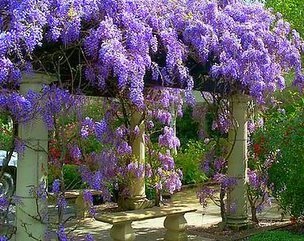
"Glicinias" (Wisteria sinensis) in all its glory


Today, the Mother of this blogger of yours is a little child, as we say about someone's birthday. Hopefully the wisteria will be in full bloom, the good omen Spring brings to Her every year.
Natercia is a name that only exists in the Portuguese-speaking universe. The great Camoens having fallen in love with a Princess of Royal blood, Caterina, and prevented therefore to use openly her name in his romantic poems invented the anagram. Caterina / Natercia. Clever, no?


Parabéns a Você!
Nesta data querida
Muitas Felicidades,
Muitos Anos de Vida

Hoje é dia de Festa
Cantam as nossas Almas
P'rá Menina Tessinha
Uma Salva de Palmas


Happy Birthday, Dear Mum!

Monday, March 27, 2006

Diego Velazquez


Some new "Las Meninas"-inspired paintings..

Posted by Picasa

Pytagoras


A test of geometry for 14 years old. ( Based in a true story.)
Posted by Picasa

Antonia Fraser


Stupidity as a not sufficiently studied force in Politics...


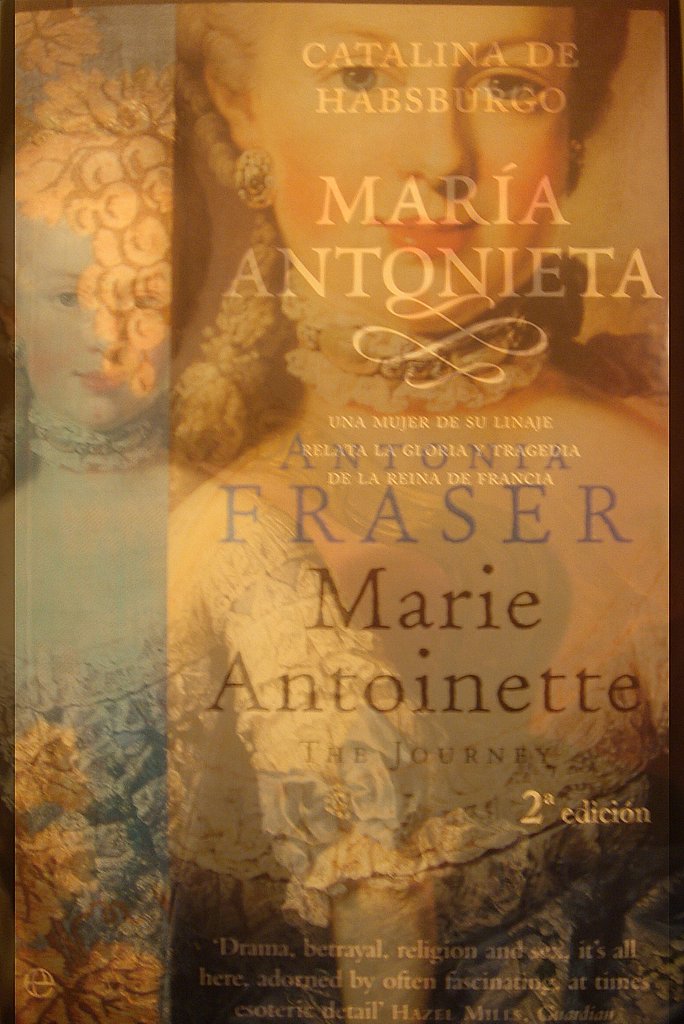
Overlapping biographies of Marie Antoinette: Antonia Fraser's and Catherine of Hapsburg

After reading the really excellent biography of Marie Antoinette by Lady Antonia Fraser for reasons I will make clear to the Right Honourable Reader in a few lines, I got curious about what possible further contribution could a recently published book on the same Hapsburg-Lorraine Queen, written by an Hapsburg-Lorraine herself, be able to do. Answer: none.

Anyway, what has bring this blogger of yours close to the readership of "Point de Vue-Images du Monde"? A "sans-noblesse" attraction for royalty? An eagerness for gory stories of execution by guillotine? No, the Right Honourable Reader can sigh with relief , my motives are more worthy.

If you want, it's the "kaleidoscope effect" all over again. Not the "what if" school of revisionist history but the sense one accumulates through life that pure chance many times plays an enormous role in political upheaval. The pet obsession of this blogger of yours regarding understanding politics is to use "Russian Revolution" as the case-study to illuminate the different angles of a political process. Ideology, hard data on events and social context, the psychology of the main actors, all that political "bouillabaisse" should be tasted like a thinking-man's delicatessen. One should be able to acquire the ability to recognize thereafter the "essence" of a revolutionary process.

So, I read books on the French Revolution mostly as background to the "real thing" (Petrograd, 1905 to 1917 and thereafter) .

What strikes any reader of both revolutions is the psychological likeness of the two family triangles: LouisXIV-Marie Antoinette- the Dauphin; Nicholas II - Tsaritsina Alexandra Feodorovna - the Tsarevitch.

In both cases we have a flawed wimp of an husband, stupid according to all definitions of that whimsical quality, burdened by an enormous inferiority complex and feelings of inadequacy, dealing with a self-centered wife carrying whatever the dire circumstances the fixed obsession to keep the crown (imperial or royal) alive for her son to inherit it .

Sheer stupidity has never been sufficiently underlined as a important contribution to political debacles. (On the other hand, one has only to remember the exceptional intelligence of Stalin to be shy about making much out of I.Q. in rulers). In the cases of Versailles and Tsarskoe Selo to put the lack of brains of the Sovereigns on the spotlight is to cry out one of the inherent shortcomings of the monarchic principle. A good First Minister, an able Chancellor, a reasonably effective Council of State could perform near-miracles in camouflaging their Sovereign's intellectual shortcomings when the political weather was stable enough. But in times of high political barometric pressures, with storms gathering force, the lack of a quick calculating brain at the head of the institutional machinery was an irretrievable flaw.

To make matters worse, both Sovereigns, the French and the Russian, believed piously in the Higher legitimacy of their power, somehow believing their crucial reasonings (no matter how slow and clouded in its processing) were inspired, if not dictated, by God Himself.

Back to Marie Antoinette. The edifying story of her last weeks alive cannot hide the fact that pure dumbness, political frivolity and lack of substance brought in Terror. Just like in 1917..


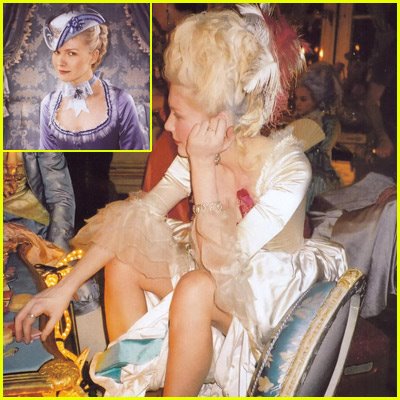
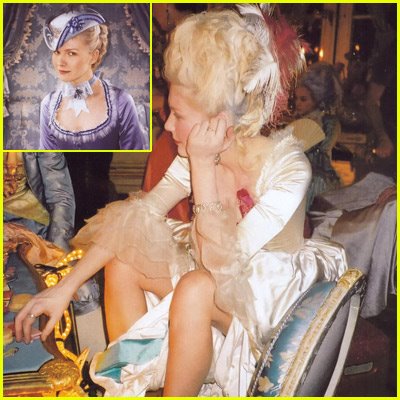
Kisten Dunst as Marie Antoinette in the forthcoming picture based on Antonia Fraser's biography

Wednesday, March 22, 2006

Gerry Adams


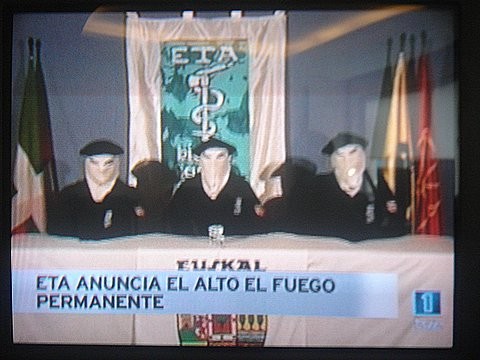
"Euskal Herrian, 2006ko martxoam"


Reminds one of the whole IRA cease-fire stuff...
Light at the end of the tunnel?..
Good luck to all the negotiators...
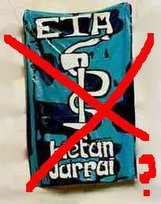
I might add a little story or two to my parsimonious legend to the digitally manipulated ETA's logo. I'll dive again into my diplomemories, if the Right Honourable Reader has nothing against it.
Two decades ago, in the capital of the Kingdom of Great Britain, I was given the brief to follow and report from time to time about "Northern Ireland" (as was customary at the time to keyword it for our readers' attention. Neither "IRA", nor "terrorism in Northern Ireland", nor (God forbid!) "Irish Question"...). I was quite young then but sufficiently wise to keep my mouth shut and my thoughts for myself for more than a year about that issue. In the meantime I read a lot (history and left-wing revolutionary politics are always the keys to understand modern self-determination struggles in Europe), I listened a lot (including the overtly pro-United Ireland "Fringe Meetings" at Party Conferences of Neil Kinnock's Labour ) and I started to probe a willing expert or two. Time had perhaps come to make up my own mind about what could be done, in my humble views at least.
And that takes me to my little story, short and with a puzzling morale. The scene takes place at another Party Conference, this time the Tories (which were in power at the time), in one of those after-Plenary drinks-parties which were held in large rooms of the seaside hotel which doubled as HQ to the meeting. Someone introduce me to a quite charming and well-rated Member of Parliament. We exchanged cards after a while, when empathy had become obvious. After answering his question about what dossiers was I following at the Embassy, the good-mannered MP, who had been involved in "Irish" issues for quite a long time, asked me what in my view could be done to get the IRA black-cloud out of British political skies. With all my youthful naivete, believing in my right to state the obvious, I said: "I guess.. you'll have to discuss with Sean Feinn". The MP's reaction was for me quite a shock ( I still remember it, as in slow-motion film). He just turned his back on me and went away.
And the point is? - the Right Honourable Reader might ask. Well, it was obvious for a third party observer that the British government would have at some point to consider the unsavoury move of dialoguing with the political wing of an armed/paramilitary/terrorist group if it wanted to make some real progress. But inside the political decision-making machine that move was still a tabu. (Years later, mostly with Blair but also with Major before him, that was of course the path to follow).
Am I saying that talking with Batasuna or the coming to power (in Madrid) of a young socialist PM has analogies with what happened in the British Isles? I'm sorry but I have to decline to comment on that. I know nothing about ETA or the Basques, and I will go on keeping my mouth shut.
Just one final little story, heard from the mouth of the nowadays most influentiall compatriot of mine in Brussels. That gentleman, with whom I have spent years in the same classroom of an old-fashioned Liceu, was very busy at some point of his foreign affairs-related career trying to bring close together the political stands of the two Angolan warring factions. He told me at the time something I keep remembering: "The fact that the International Community has a pretty good idea of what needs to be done is not enough. Even if the IC has a number of coercive means up its sleeves the crucial thing remains to be obtained: that the parties of the conflict themselves believe that the time for serious dialogue has come. We cannot impose peace if they're not ready in themselves for it."
My argument therefore is something like this: the path to overcome a conflict might be obvious for some time to the outside world but unless it becomes obvious too for the belligerent parties at a deeper interiorized level that "solution" is perhaps better kept silent. Besides, no one likes when someone turns his back on you...

Manuel de Falla


At the Opera one should never ever forget to swicht it off...
 Posted by Picasa

Tuesday, March 21, 2006

La Cicciolina


An ad, in today's newspaper, to an erotic fair outside Madrid...
Posted by Picasa

Giacomo Puccini

'Mycobacterium tuberculosis'...


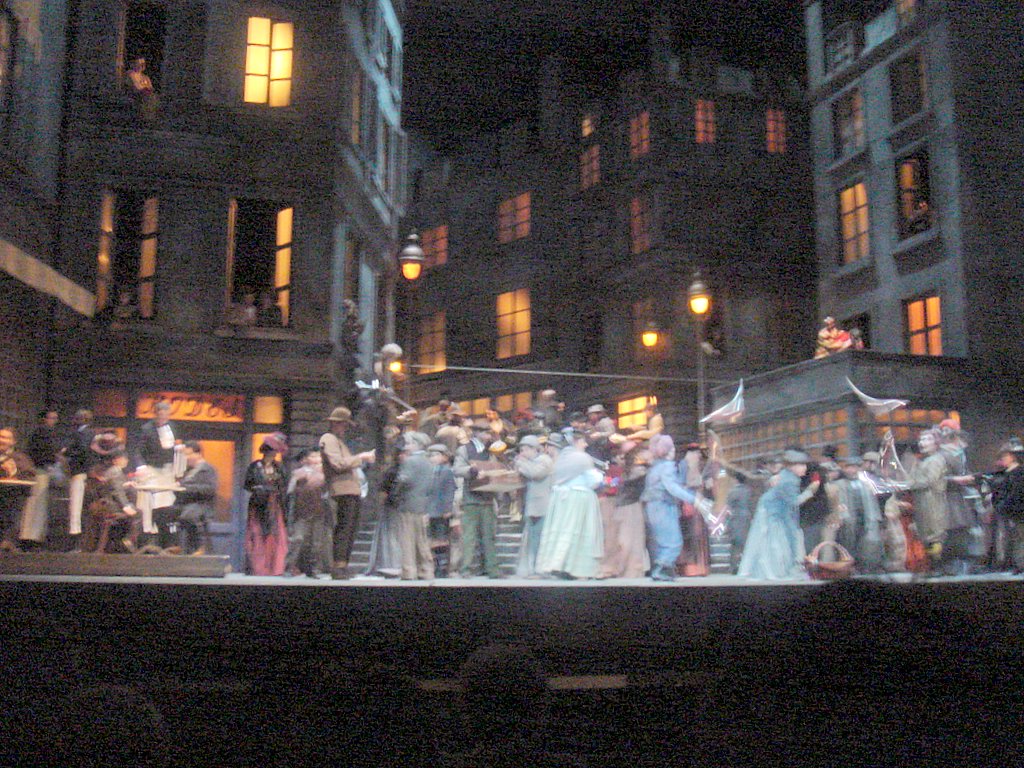
The zefirellish ACT II of "La Bohème" at the Teatro Real..


MayaMalinkaRusskaya had never seen "La Bohème" live and on top of that she had not set foot on the Teatro Real yet. After lengthy appraisal on-line of all the available seating options I managed to get two Butacas de Patio (Stalls, 4th row) which have cost me around six times the price of a first class DVD of the same opera.
As is the case with every B+ operahouse in the world (A+ being Glyndebourne, Met, Scala and Bayreuth; and A being Covent Garden, Salzburg, Palais Garnier, etc.) an academic merchant-ivorish lavish production is a bit of a bore. Only exceptional singers can carry with them boring ruskin-approved art directions, and we all know B plus opera houses cannot afford exceptional singers. Am I being snobbish here? Shouldn't one visit a zoo after having been on a safari? Of course one should. There's always something new coming to your mind when you are in automatic listening mode during Act IV ( I guess if one was listening to Mirella Freni playing Mimi one would never found oneself in automatic mode..).
This time, as Mimi (the rather wonderful Inva Mula) was dying of consumption in between some really amazing pianissimi, I thought of my old friend, the Koch Bacilus . In this blogger of yours' previous life some afternoons of his Microbiology-related job were spent teaching a dozen medical students the lab tricks of a diagnostic of Tuberculosis. Compared with the relatively plain methods to isolate "plain" bacteria the colourful paraphernalia needed to deal with TB was a sure hit among students. I guess that at this point I should mention also the young soldier dying from a multiresistant strain in the room next to the Room-of-the-Officer-on-Duty at the Military Hospital for Infectious Diseases where I was resting - but, even twenty years later, that slow asphyxia intertwined with paroxistic anxious cough it's too painful to evoke ).
An idea came to my mind as Musette was leaving the scene to satisfy Mimi's last wishes: mass popular culture ( like Opera in the XIX century or movies nowadays ) requests a dying young main character expiring from the disease-of-the-age. Mimi was dying from Tuberculosis, as Ali Mc Graw was dying from Leukemia (in "Love Story") and as Tom Hanks was dying from AIDS (in "Philadelphia").
I thought I had just stricken blogging gold so I turned off my automatic pilot and proceed to enjoy the dying moments of Puccini's "La Bohéme"..
*
Now, the day after, I realize, once again, that there's a book or a paper published somewhere about that very same idea you took for reasonably original. After googling "Opera + tuberculosis", as an honest researcher toiling to impress positively the Right Honourable Reader should do, I came across a reference to "Opera: Desire, Disease and Death" by Louise and Michael Hutcheon.
In that book, co-written by a Professor of Literature (Louise) and her medical husband, Michael, a Professor of Medicine, one can find chapters on "The tubercular heroine" (in La Boheme and La Traviata), or syphilis and Parsifal or on pox and Lulu and Rake's Progress . It looks it might justify some Amazon-ordering.
Agony is a powerful ingredient indeed not only in novel-writing but on libretto-writing too (and in script-writing for sure). It remains a quintessential element of melodrama and an almost unfairly easy device to provoke a strong emotional response from the public (novel-reader, opera-goer or movie-watcher.)
Leaving these mental digressions aside, was the instillation of Puccini's music in Scenes of Bohemian Life worth the evening out in Teatro Real? A qualified yes.
Pierre Fouque


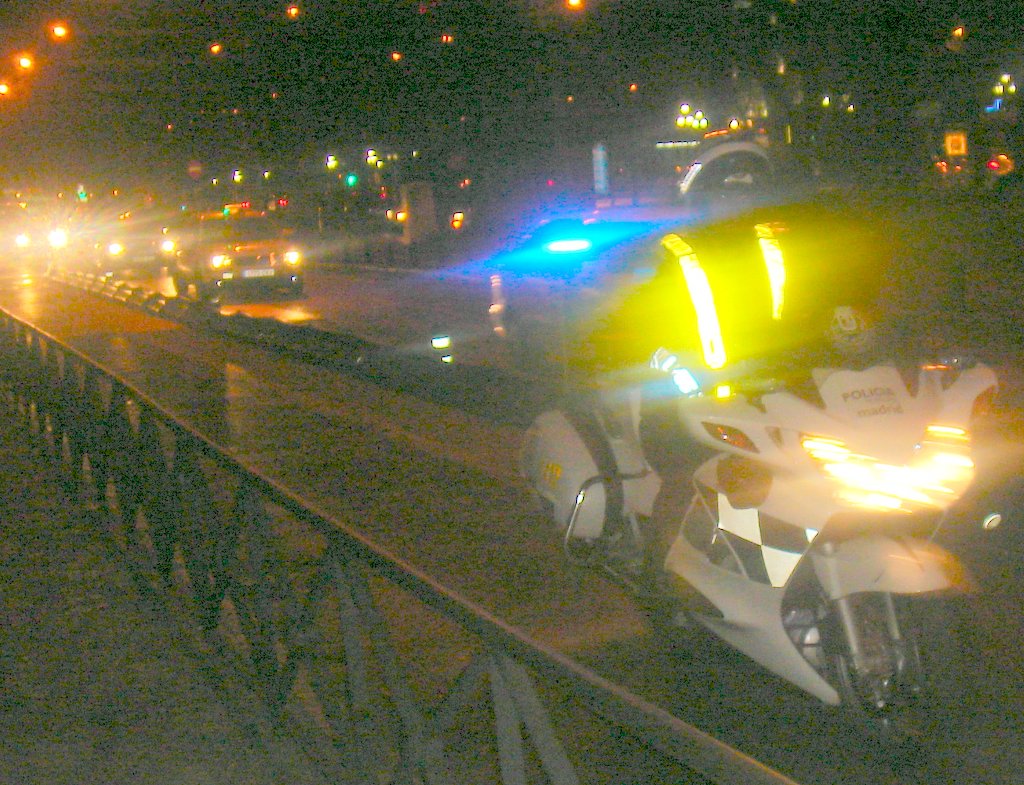
Motorcade with blue-lights flashing, Paseo de la Castellana, March 2006
 Posted by Picasa

Thursday, March 16, 2006

Nelson Mandela

Recycled farewell speeches...
The allCiudad diplocommunity has been busying itself with successive farewell parties to honour JazzCool, the departing Ambassador from the huge southernmost chunk of Africa. This blogger of yours went to two of them, an honest performance-as-blogger statistic.
The first one was at the Puerta de Hierro imposing mansion of DerIngenier, that old Madrid acquaintance of this blogger of yours and therefore also of the Right Honourable Reader. The speech from the exiting HoM (Head of Mission) or CMD (Chef de Mission Diplomatique) was the traditional blend of debating accuracy, serious soundbites, sentimentality and near-veaudevillesque histrionics. The whole routine of a pro! Quite effective, one might add, while taking mental notes for future personal farewell toasts.
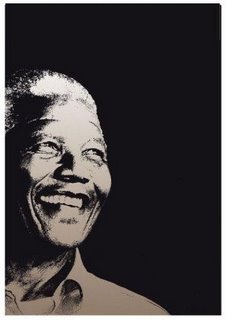
An enormous selling point for a diplomat from that country, or for any national from it for that matter, is the iconic status of President Nelson Mandela. The SouthAfrican Statesman's charisma is a kind of stardust that confers upon those who get close-by a kind of glow that shows...
At the second party, in downtown Calle Serrano, hosted by the Bielayaprinceza, this blogger of yours arrived awfully late, even by Spaniard standards, and missed the speech. But Ambassador JazzCool tranquilized me by saying I hadn't loose that much since it was recycled from the previous one I had witnessed.
With the smoked salmon someone commented that Mandela was a Royal figure pretty much like H.M. King Juan Carlos in these shores. All around this blogger of yours there was endorsing bodylanguage, which was ironical given the amount of more traditional monarchists present. I intervened to recall the very last "European Tour" of President Mandela, and his stop in Cardiff, where a meeting of EU leaders was taking place. People on the streets were ecstatic and gathered in almost anti-Irak War numbers to salute the hero of the Down With Apartheid movement. With a hint of moralist nostalgia I confessed it was pleasant to see the masses demonstrating for a Statesman like Mandela rather than for a Bono or another Rock or Movie Star (an awful wordplay just came to my mind "rather William Pitt than Brad Pitt"). Guests recalled then their own meetings with the President, at one time with Reverend Tutu present.
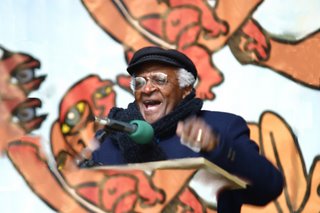
That's when the chat spotlight in the dinner-party turned to Desmond Tutu and we were told by Herhelenichighness a most delicious soundbite with which this blogger of yours will avail himself to punch-line this post. Very recently, in Seville, for a ceremony related to the Andalusian Junta-sponsored contribution to an hospital in South Africa, Reverend Tutu enchanted his audience. With his inimitable smile he thanked their charitable gesture saying: "I came to you to bring you tickets, for each and one of you, to Heaven. Just, please, wait a bit and refrain from using the tickets right away."

Wednesday, March 15, 2006

Maria Theresa, K. und K.

'Entrée' Rights at a Palace in Marquez de Salamanca...


The loo itself was of Hofburg-like grandeur...

The Right Honourable Reader knows at this point of our joint journey that this blogger of yours would not like Him to be deprived of such an unique occasion as the cocktail hosted by Biscuit, one of the last larger-than-life sovereign empresses of Madrid's social high life. The mix of connoisseur/collector hubris with the traditional high ceiling-ed boiserie was staggering. All the boxes were thoroughly ticked: the generous flowing of Taittinger; the cute dress of the in-house female servants; the professionalism of the catering waiters ( Bernardo,with silver tray and elegant pose, knew exactly the proportions of whisky and water to be served to my Library Room neighbour, Poula Letpin, a grand host of lavish dinner-parties himself).

The mix of tribes was a good one too. Not only the OldSpain ethnicity one expects in these rarefied salons but also some "riff-raff" from the Arts & Entertainment family. The image of an almost Nô-faced Lady, in heavy make-up and Andalusian hair-style, smoking a robusto cigar in the Dining Room, cannot be erased from my memory. Some representatives of the merry sex were performing their usual bridging role between Grandes and artists. But what was really striking, together with the zillion carats of the Hostess' diadem, was the omnipresence of courtiers. Our queenmotherly figure, thanks to whom we were all indulging the eleven o'clock Mariachis, commands a small Court of Close Family, Ladies-in-Waiting and hyperactive Courtiers that reminds one of the Société Privée de La Reine, the entourage of Marie Antoinette at Versailles/Petit Trianon. But the positively regal demeanour of Biscuit and the obvious charismatic power she exerts on her entourage makes one think rather of Antoinette's mother, Empress Maria Theresa herself.

The chandelier was awesome...

Many small wonders and good stories were exchanged during the evening, as it happens when the party, like mayonnaise, has all the ingredients and the cooking is first rate. One takes heart too at the politically incorrect display of photos as one could spot the severe military traits of Francisco Franco and the ambiguous monalisish smile of Doutor Salazar, posing with members of Biscuit's family. In the current days of strict boundaries in political good taste, keeping these photos in the light becomes an act of almost joyful challenge. It would be so simple to discretely move away those pictures, for a number of reasons including a couple of very good ones, but there is no revisionism of history here. What happened did happen, not some edulcorated new version of events to please all and confront no one.

This blogger of yours was rather charmed by the excellence of the English accent of the charming HassebladPortraitist, a musical enjoyment one has, hélas!, very few occasions to feel in these slightly foreign-idiomophobe lands.

Should I report a blatant case of sexual harassments which occurred during the party? The Right Honourable Reader agrees? Right. A white and 70s-style haired chronicler who honours us daily with his wisdom, a glory of this country's Belles Lettres, was visibly enchanted with the conspicuous whiteness of Mayamalinkarusskaya's complexion. He gallantlyl warned her, with an obvious enthusiasm for the Slavic biotype, against being left alone, abandoned by her husband-blogger, for more than a few seconds...


No serious party is complete without a Mariachi performance...

Monday, March 13, 2006

Italo Marchioni

"Little Italy" in the Ciudad ...


Ice-cream Girls.. Posted by Picasa
Saturday I was the happy recipient of the Honorabile Homologo's hospitality. The traditional and successful mix of interesting people, good looks and alfa-male chatting. At puddings we were feasted on ice-cream in genuine cornetti, the wafer cones we should thank Mr Italo Marchioni for. Three of the guests found themselves slurping cones at the same time, standing, like in a sandy beach somewhere in the Mediterranean. I decide to cybershoot the moment to try something new in this blog. The actual photographic depiction of the characters involved but with enough image manipulation to prevent "outside" recognition. A barbaric notion, the Right Honourable Reader might consider, for which this blogger of yours presents his unreserved apologies.
The best punch line of the night, together with the inside story of Tseretelli 's offer of tons of artistic bronze to the city of Seville, belongs to the Veterinariaconidiomas. She was studying embryogenesis in sows (female pigs) when suddenly her lab become penniless after the withdrawing of generous American grants. Either the scientists would pay for their own test animals or they would have to change job, they were told. She then decided to try some direct fatherly financial aid. To no avail. Her father told her that he could consider pay for mice but certainly not for sows. He repeated in a uncompromising tone: " Ratas Sí­, pero cerdas No".

Parvesh Sunan

Posted by Picasa


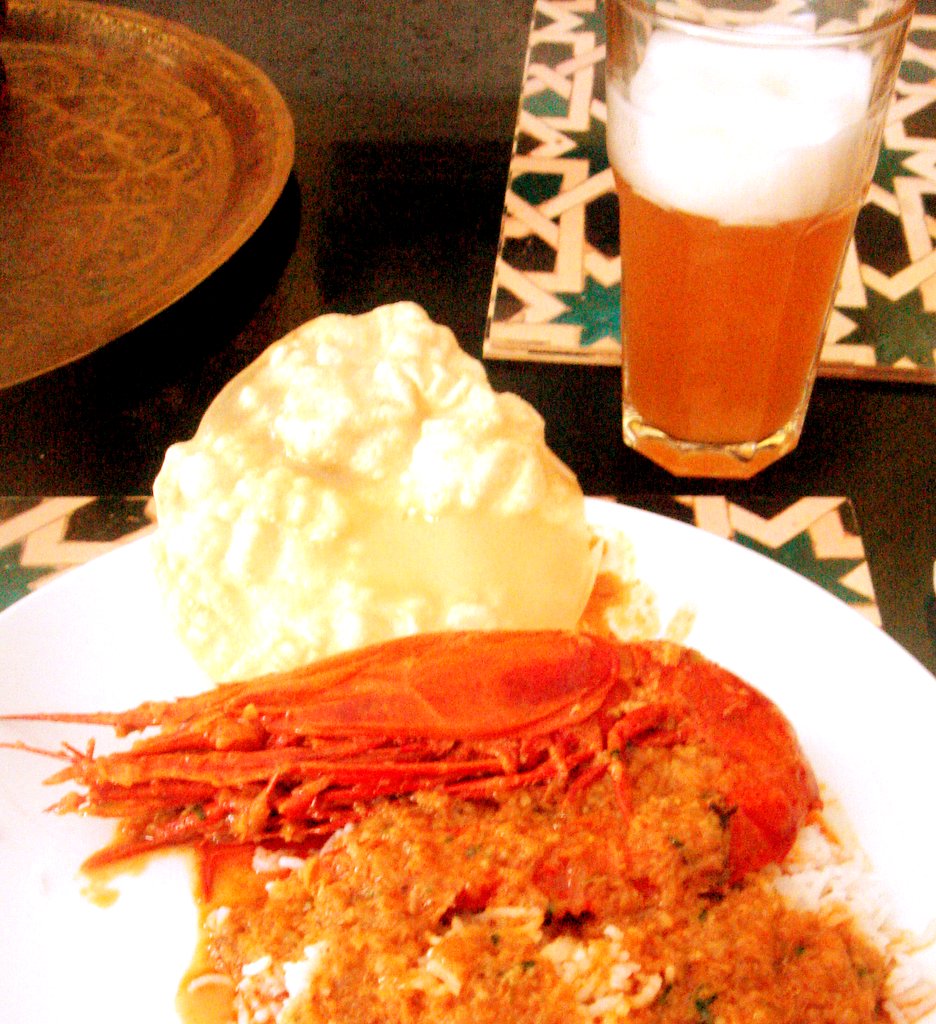
The skills of a Punjabi cook...